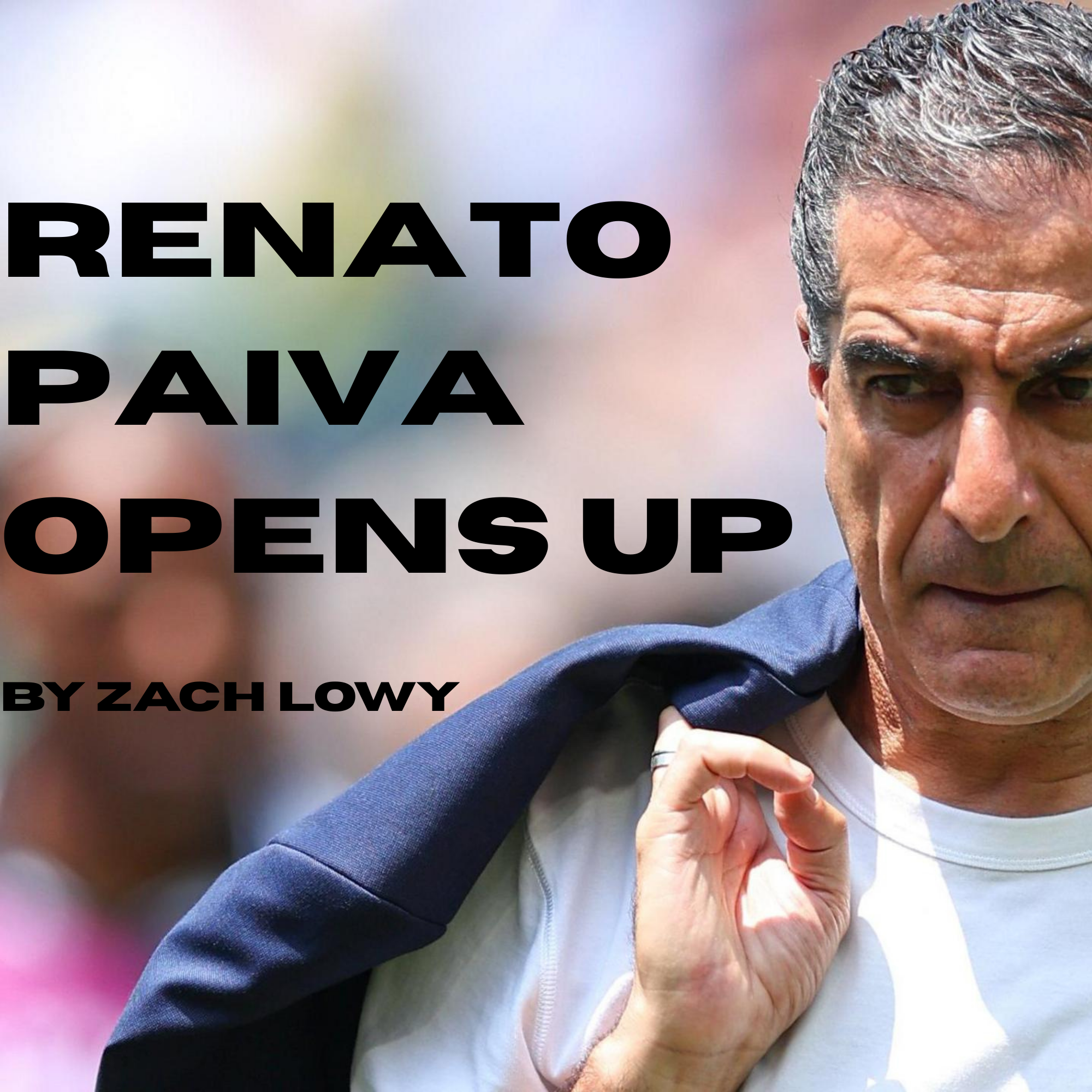
Renato Paiva Opens Up to Protagonist Soccer
Renato Paiva has spent the past five years bouncing around from Ecuador to Mexico to Brazil and carving out a professional managerial career. However, the first half-century of his life was spent solely in one country: Portugal.
Born on March 22, 1970, in Pedrógão Pequeno, Paiva was just a little kid when a group of military officers overthrew the Estadio Novo regime in the ‘Carnation Revolution, producing major social, economic, territorial, demographic changes, resulting in the Portuguese transition to democracy and the end of the Portuguese Colonial War, and marking the start of Portugal’s third wave of democracy.
“I was four years old, I had little or no idea what was happening, but many things began to open up,” stated Paiva in an exclusive Protagonist Soccer interview. “Even during the dictatorship, football was something the dictatorship heavily promoted in Portugal because they wanted people to focus on football and not on other areas, so this allowed the dictatorship to function smoothly. As I turned seven, eight, nine, and ten, we started to have a society open to sports and cultural activities. Society started to open up to young people, which was very important for the development of sports in the country. We began to have the professionalization of sports teachers and coaches, and everything improved. Society has improved in terms of becoming more open and free, we’ve stopped having so many prohibitions, so many borders, and we’ve started to take over the space to free ourselves not only athletically, but also culturally and socially. I grew up in an era where there were no cell phones, Internet, or Google, and where computers were extremely rare; I didn’t get my first computer until 1988/89. It was all very humanized and relationship-based, from the touch of friends who plan to go play soccer on the street, to friends who plan to go to the movies.”
“You were obliged to follow the rules, you were responsible for the schedule you set: ‘We're going at three o'clock to play football every day. Whoever isn't there at three, he picks up his cell phone to make a call and ask where the person is. Before, there wasn't that; there was responsibility. If I scheduled for three o'clock, then I’d be there at three o'clock. All of those social relations were very human; they were very focused on human things, on personal matters. And today, society is very impersonal. Society today is about the click of a button and immediacy. You press a button, and things start working…it's changed in that respect. I was very happy without cell phones and the internet, but today, I also know how to live both ways. I have to understand it for my work too, I have to understand how to live with the rules of the internet and the phone and everything else.”
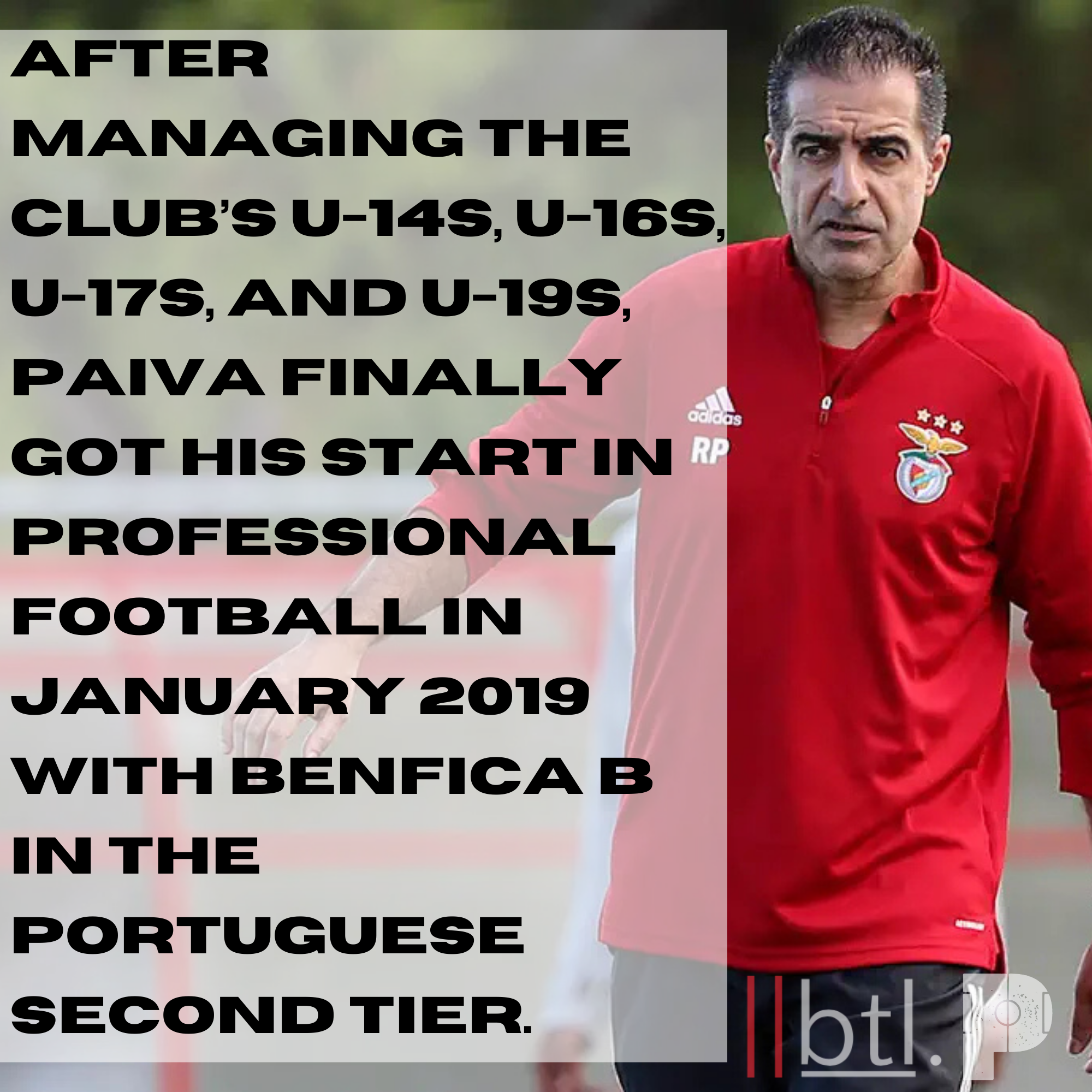
Whilst Paiva dreamed of becoming a professional soccer player, he was forced to put these ambitions on the backburner after turning 16, after having to choose to go to school instead of training in the morning. Nevertheless, he remained keenly aware of the potential value of soccer, playing at the amateur level and reading magazines like Onze Mondial. Similarly to others like Dave Johnson and Rod Underwood, he refused to allow his lack of playing success to prevent him from establishing a career in the soccer industry. Eventually, he got what he was looking for after joining Benfica in 2004 and helping to establish them as one of the top academies in the game, working with future stars like Bernardo Silva, João Félix, Renato Sanches, Gonçalo Ramos, Ederson, João Cancelo, and Rúben Dias. After managing the club’s U-14s, U-16s, U-17s, and U-19s, Paiva finally got his start in professional football in January 2019 with Benfica B in the Portuguese second tier. He spent two years in charge before making the move to Ecuador in December 2020 and taking the reins at Independiente del Valle, where, in his first ever top-flight campaign, he guided IDV to their first-ever league title.
“The club had never been a national champion, it’s not even one of the Big Three – Liga de Quito, Barcelona, and Emelec – which are are powerful clubs in terms of titles and fan base. Independiente was a growing club; our stadium had 5,000 fans, and there weren’t many Independiente fans outside the city in Ecuador, but we found all this tranquility. The beautiful story here is that in my first year of professional soccer, we ended up winning the national title that Independiente had never won before. It's Independiente's first major national title with our coaching staff. They had just won the Copa Sudamericana, with Miguel Ángel Ramírez leaving for Internacional in Porto Alegre. We replaced him and played in Copa Libertadores third qualifying round, where we met Inter’s rivals Grêmio, coached by Renato Gaúcho. We managed to eliminate this Brazilian powerhouse and qualify for the group stage of the Libertadores, something that was unthinkable if you look at the Grêmio team.”
“This was the first major achievement we had in March and then, at the end of the year, we ended up becoming national champions and winning our first title, something that they haven’t done ever since, although everything points to them winning it this year. So this wonderful story has emerged from beyond the title, where we had the ability to launch young players like William Pacho, who is now a center-back for Paris Saint-Germain, and Joel Ordóñez, who is now a center back for Club Brugge, and Pedro Vite, who left for MLS but currently is at Liga MX side Pumas, and Jhoanner Chávez, who’s now with Ligue 1 leaders Lens, and José Andrés Hurtado, who’s currently a full-back for Red Bull Bragantino. There were a lot of young players from the Academy who, in addition to us winning the title, we developed those players and they ended up being big sales from Independiente.”
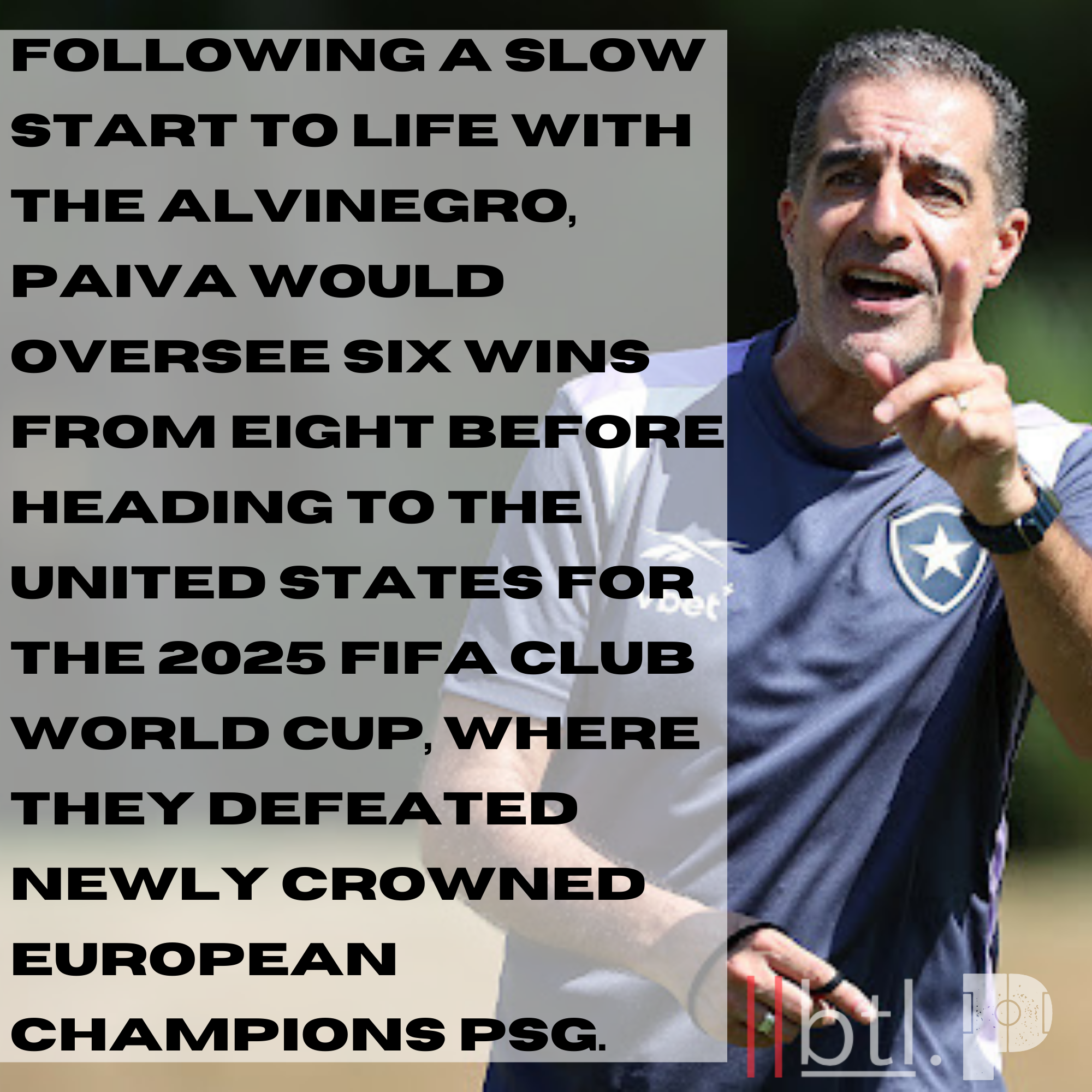
Paiva departed after 17 months to take charge of Mexican side León, where he lasted just six months before resigning. Eight days later, Paiva returned to work as the new manager of Brazilian outfit Bahia, where he guided them to the Campeonato Baiano before handing in his resignation after nine months. He then returned to Mexico and planted the foundations for Toluca’s sensational 2025, before making the move to Botafogo, who were coming off their first-ever Copa Libertadores title as well as their first league title in three decades. Following a slow start to life with the Alvinegro, Paiva would oversee six wins from eight before heading to the United States for the 2025 FIFA Club World Cup, where they defeated newly crowned European champions PSG.
It wasn’t enough to save his job; 10 days later, after falling to an extra-time defeat to Palmeiras, he was sacked. He was only out of work for two weeks before taking charge of Brazilian side Fortaleza, where he lasted just 10 matches before being given the boot on September 1. As one of the most highly valued available managers in the game alongside the likes of Xavi Hernández, Danny Higginbotham and Thiago Motta, it’s seemingly only a matter of time before Paiva returns to the coaching industry. But for now, he’s happy taking his time in Rio de Janeiro, reflecting on a turbulent 2025, and planning the next step in his burgeoning managerial career.
“I know that in soccer, winning titles is what counts when it comes to your legacy. I loved spending 18 years training players at Benfica, I'm passionate about individual player development, and whether I won or not, nobody can deny that the players on my teams have always improved on an individual level, be that at Toluca, Bahia, Independiente del Valle, or León. There are a lot of players who started with us and who are now on big Mexican teams. Of course, everyone wants to win, and the more titles I can win, the better, but that’s my legacy. It's more of a human legacy than a legacy of titles.”
“I’ve contributed my part. I contributed to these children today so that they and their families’ dreams come true. Many years have passed, and they haven’t forgotten me, they continue to spend me messages, and I continue to be a part of their lives. That is their greatest legacy that you can have: it's about humanity and human legacy. Because football is made by people and for people, and we can never forget that. Before I see a player, I see a man. I see a human being who experiences sadness, frustrations, joys, and personal problems. And when this happens, it often influences their performance. I can't turn my back on this. So this is how I view my career; I want to continue developing players, I want to continue launching players, because that, in fact, is what I do best.
- by Zach Lowy