Do Not Be Misled by Imitators: The History of Pants Store FC
The 1924-25 season was the St. Louis Soccer League’s (SLSL) tenth as a professional organization. It would kick off with four teams competing for a title. The standings included the legendary names Scullin Steel (the Steelmen), Ben Millers (the Hatters), Vesper Buick (the Automen or Buicks), and finally Pants Store.
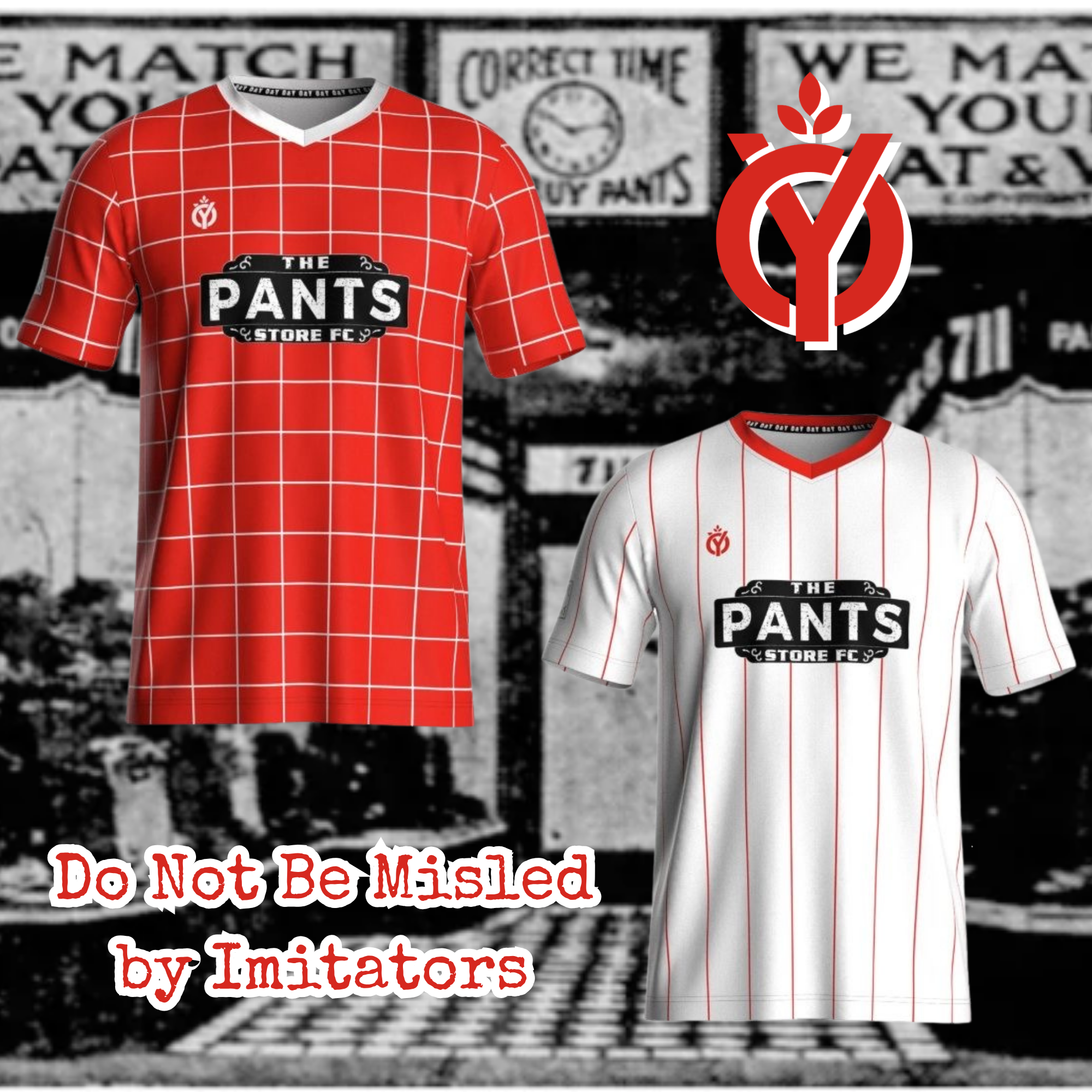
With a name that sounded like a joke straight out of “Anchorman: The Legend of Ron Burgundy” Pants Store FC, also known as the Pansies or the Raticans, lived a brief but eventful life. They would experience trials and tribulations that resonate even to this day. Pants Store FC, while not the most famous team, helped to build soccer in America just as surely as any other squad that has ever suited up.
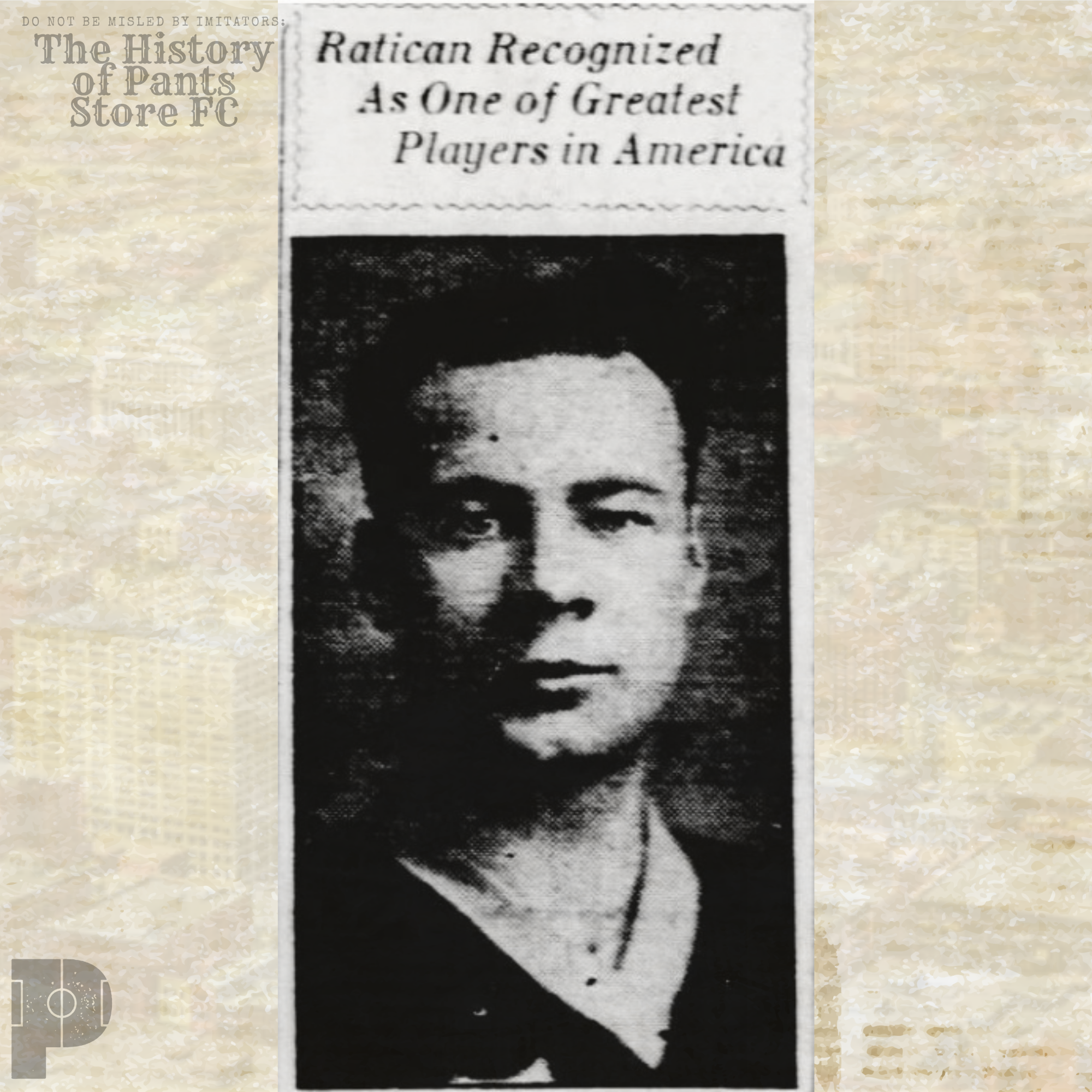
Every team needs a coach and Pants Store’s player/coach was a proper legend. Harry Ratican was born in St. Louis, MO and graduated from Christian Brothers College High School. His alma mater holds the unique title of being the only high school soccer team to win an Olympic medal, securing the silver during the 1904 Olympics.
Ratican turned pro around the age of 18 and never looked back. During his career he would play with notable teams such as Ben Millers, Bethlehem Steel, and Fall River. He went on to play in and win multiple championships and set scoring records. In 1922 he began his coaching career at West Point. In 1923 he wrote a soccer advice column for the St. Louis Post-Dispatch. By 1924 Harry Ratican was considered one of the greatest American players of all time.
By what means, Harry Ratican’s soccer team acquired the style and title Pants Store is a tale of abandonment and desperation. During the 1923-24 SLSL season Harry Ratican coached the Ben Millers to a last place finish. On October 1st, 1924, the team owner, George Miller, decided to buy the Barrett-Hoover team. The sale price was rumored to be between $3,000-4,000 ($58,700-78,300 in 2026) and the St. Louis Post-Dispatch reported it was the first time a franchise had been sold for cash in SLSL history. Barrett-Hoover would now be the Ben Millers and with less than two weeks until kickoff Harry Ratican was left scrambling to find a sponsor for his nameless team.
As opening day approached Ratican claimed to be fielding sponsorship offers from a number of suitors. Despite that, his team was without a sponsor and took the field as the Raticans. Things did not go even remotely close to well. The Raticans lost to Ben Millers 6-0.
Charles J. Bartley of the St. Louis Globe-Democrat said they, “Displayed a very poor article of soccer in their initial contest of the year.”
The opening day was notable for the fact that three of the four coaches in the league suited up for their teams. A far cry from the modern game. Harry Ratican counted himself among the players/coaches.
Week two would see Ratican still claiming to be receiving sponsorship bids while his team remained unnamed. The Raticans tied Vesper Buick by a score of 2-2.
Drawing 2-2 was certainly better than the 6-0 drubbing from the week before. As Jack M. Van Pelt of the St. Louis Star said, “much to the surprise of the spectators, the Raticans put up a wonderful brand of football.”
Leading into week three Ratican signed goalkeeper “Dutch” Oellerman from the Bethlehem Steel. Oellerman had previously played in the SLSL for Scullin. The new keeper wouldn’t be of much help; the Raticans lost to Scullin Steel 2-0. During the game “Buddy” Brengle fell down while attempting a penalty kick for the Raticans.
By November 2nd, 1924, Ratican had finally found his sponsor The Pants Store Company located on 713 Pine Street St. Louis, MO. Pants Store FC was finally born, and they proceeded to lose 4-1 to the Hatters of Ben Miller.
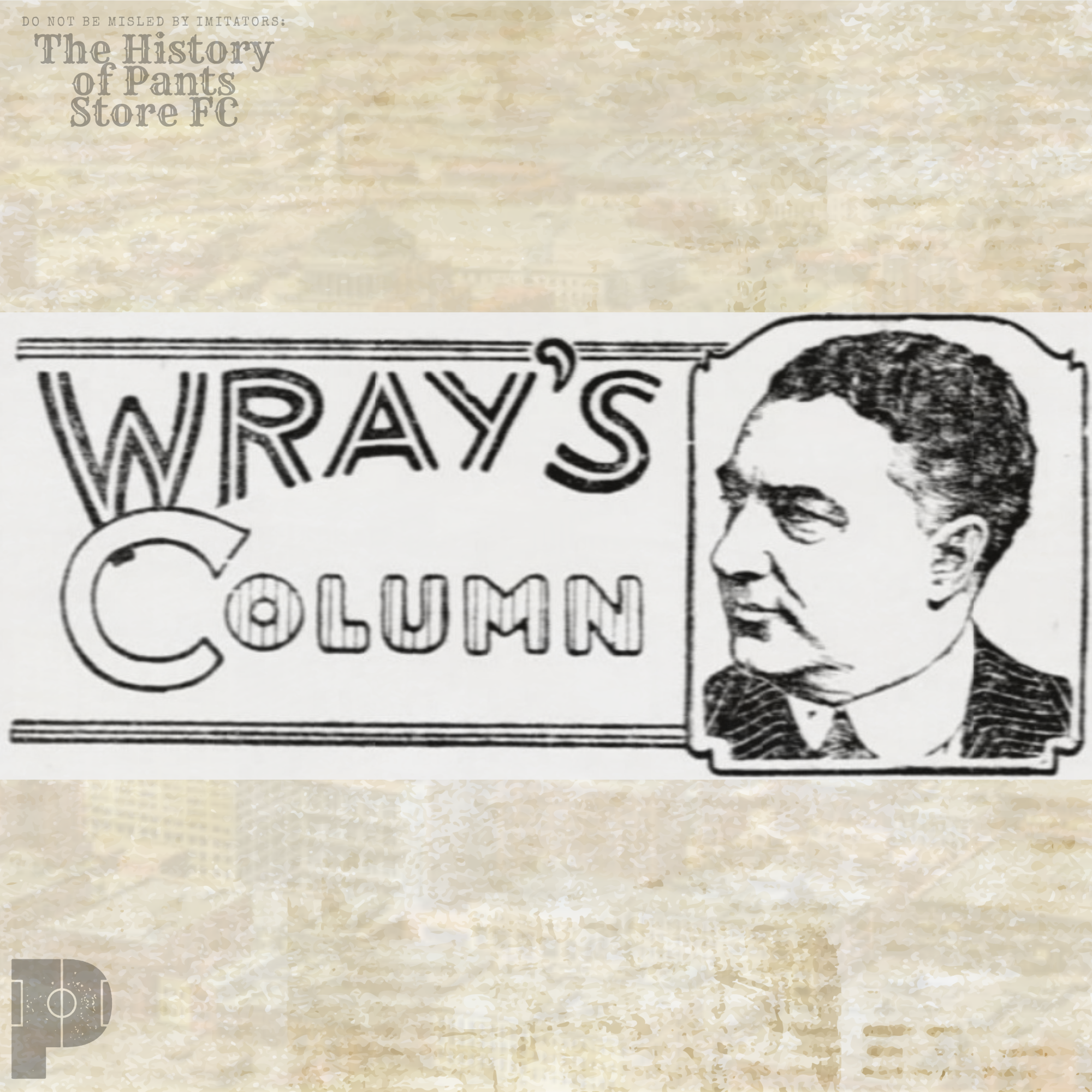
The Pants Store moniker was poorly received by at least one St. Louis area newsman. Ed Wray of the St. Louis Post-Dispatch bemoaned the commercialization of the game. It seemed the Pants Store name was the straw that broke the camel’s back.
In his column Wray laid into the teams of the SLSL saying, “For the price of a set of uniforms and a monthly salary to the manager of the club the team sacrifices its dignity and barters its individuality to serve the mere advertising ends of a business concern.”
Wray’s wrath would not end there. He was an extremely influential force at the Post-Dispatch during that time, and it seems he held a grudge against Pants Store FC because never again would the Post-Dispatch refer to them by their sponsor’s name. The Post-Dispatch would only ever refer to Pants Store as the Raticans.
Wray ended his tirade about the corporate cheapening of the game with a prophetic line, “The ‘Pants’ are doomed to be kicked around, we fear.”
The next week Pants Store lost to Scullin Steel 1-0. Then they lost 2-0 to Vesper Buick. During the Vesper game Pants Store goalkeeper Oellerman, in an attempt to clear his area, threw the ball against a Buick player and it rebounded back into the net.
Dent McSkimming of the Post-Dispatch said, “Ratican forwards the sorriest combination to represent a pro team in St. Louis in years.”
On November 23rd Pants Store lost 5-0 to Ben Millers. Jimmy Dunn who just two weeks earlier, had been playing for the Pants Store scored a brace for the Hatters. One of his goals was shot so hard it tore through the net. They would lose the next two games 2-1 and 2-0. Going into the Christmas break the Pants were winless and drama was coming to the SLSL.
During this time players from the SLSL were paid via a share of the gate receipts from matches after expenses and a 25% cut for the league. After some holiday exhibition matches, players became suspicious of being stiffed by the owners and banded together to demand a representative of the players be permitted to examine the gate receipts.
The players also demanded an increased share of gate receipts, representation during the selection of out-of-town opponents, a 10-day notice rule before a player’s release, a monthly meeting between the owners, coaches, and players, an annual benefit game to raise money for a player insurance fund, and improvements to the facilities at St. Louis University Field where all league matches were played.
If the players’ demands weren’t met, they threatened to strike.
Coming out of the break the Pants pulled up right where they left off losing 5-3 to the Ben Millers. Afterwards, Harry Ratican threatened to release goalkeeper Dutch Oellerman because of, as he said, “Too much monkey business.”
Oellerman had become a fan favorite because of his in-goal antics. According to Ray J. Gillespie of the St. Louis Star,
“His little skits and stunts have gained him many cheers from time to time from local fans, for he could dribble the soccer ball as though he were playing basketball, stand on his head in making fancy stops, dive headlong to nab the oval, or accomplish any number of tricks other goal tenders never thought about. But it seems that his little capers have not won any games for the Raticanites.”
With Oellerman still in goal, Pants Store tied their next game 2-2 against Scullin Steel. The second, and game tying, Pants goal was scored when the Scullin keeper and Pants Store’s “Doggie” Schimmel collided while contesting a ball. The ball bounced off Schimmel and as both players lay writhing on the ground it slowly rolled into the goal. The Pants would drop their next game against Vesper Buick by a score of 2-1.
Then it finally happened. On February 1st, 1925, Pants Store FC won its first game 2-1 over the Ben Millers. The Hatters went up early with a goal after just two minutes of play. From there it was all Pants with goals by Hensick and Schimmel. The Hatters made a late push but a series of saves by Oellerman secured the victory. The field was muddy from rain and the dreadful field conditions benefited Pants Store because it slowed down the more talented Ben Millers. As McSkimming described it,
“Brute strength was at a premium yesterday because of the sticky condition of the muddy field. Whenever there was a tilt for possession of the ball, the stronger man came out the winner and the smaller fellow, no matter how skillful, was left floundering.”
Pants Store FC now had a record of 1 Win 10 Losses 2 Draws with a -14 Goal Differential; everything was coming up Pants.
On February 5th, 1925, players of the SLSL voted to go on strike. Labor strife had been building since the Christmas break. With players laying out a list of demands. By February ownership had acquiesced on almost all of labor’s demands. Except the most important one. Pay. The players were paid with a split of gate receipts after expenses. The status quo was ownership received 25% and the players received 75%. The players wanted an 80% share of the gate. Winston E. Barker the chairman of the board of directors for the SLSL claimed that the current contracts between the teams and the St. Louis Soccer and Exhibition Company were binding for the 1924-25 season and would need to be changed.
No league games were played the following weekend. It was the first strike in the history of the SLSL and perhaps the first strike in the history of American soccer. On June 12th the strike came to an end. Players for three of the four teams received a set per game salary of $10 a game for wins and $7 for losses ($195 and $137 in 2026). There was no mention in the newspapers of how much would be paid for draws. Players from Pants Store FC continued to be paid a percentage of gate fees. The Pants Store players agreed to the less satisfactory deal because the team owner, Harry Ratican’s mother, could not afford guaranteed salaries.
In their first game after the strike Pants Store defeated Scullin Steel 1-0. They then lost 2-1 against Vesper Buick and tied a pair of games by a score of 2-2 against the Hatters and Steelmen.
Going into the final match of the season the Pants Store eleven had a chance to play spoiler. They were facing off against the first place Ben Millers who had only a one-point lead in the standings over Vesper Buick. A Pants Store win and a Vesper win would snatch the title from the Ben Millers and their owner George Miller who had left Harry Ratican and his players in the lurch by buying another team two weeks before the start of the season.
Pants Store lost 3-1.
They finished the 1924-25 season in last place with a final record of 2 Wins 12 Losses 4 Draws and a -26 Goal Differential.
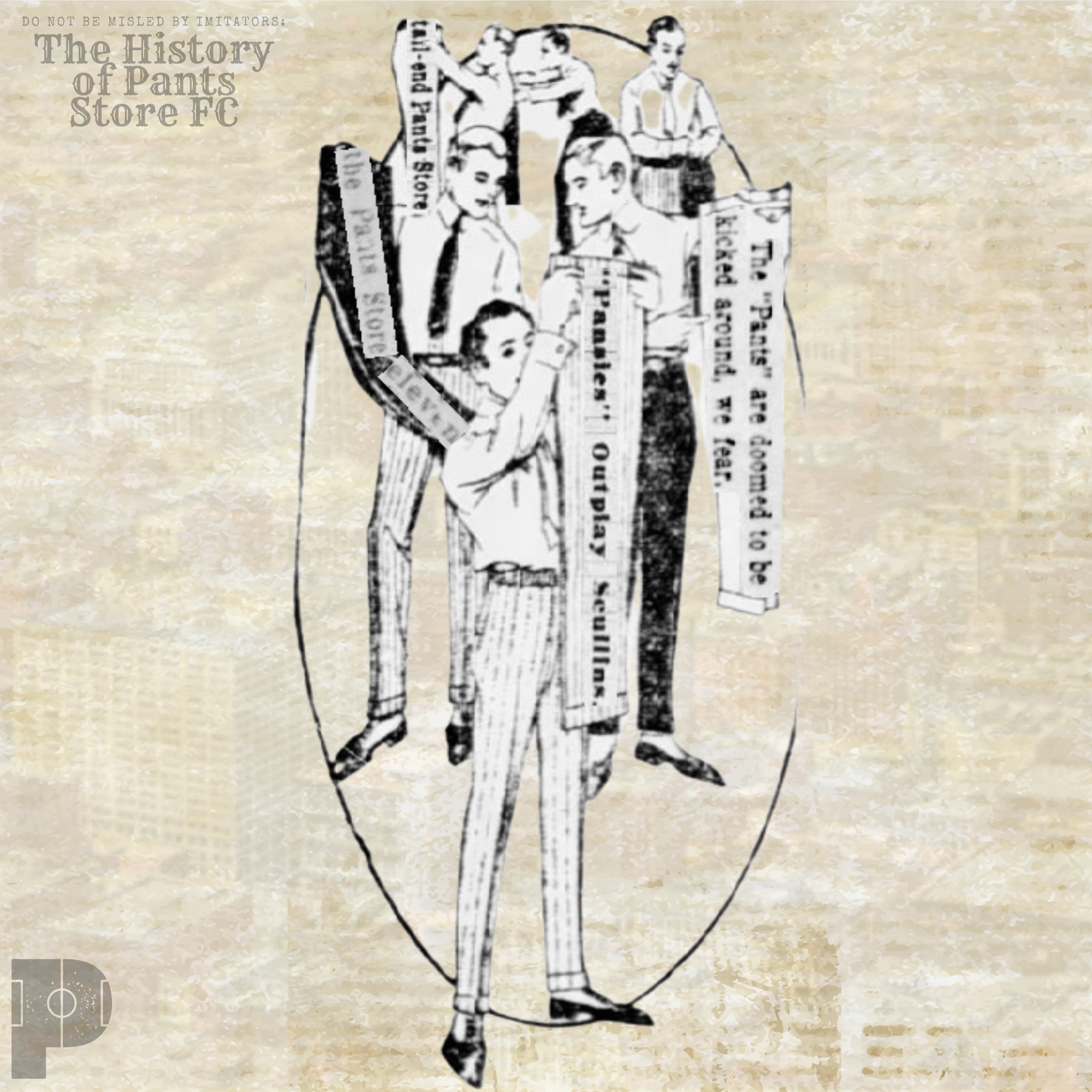
The Pants Store Company prided itself on having a wide selection of fabrics and prints meaning they could “Match your coat and vest. Any size – any color.” This led to a claim in their advertisements that they had the “Largest stock of odd pants in St. Louis.” Through low prices they promised to help customers extend the life of their suits. The Pants Store Company bought a considerable number of advertisements in local papers, as was common at the time. Their ads ran the gamut during the years Pants Store FC existed. Some had a very interesting tag line “Do not be misled by imitators.”
There is a sort of neurotic self-consciousness in American soccer. A need to not be seen as mimicking international football. A constant competition to measure up against the big leagues of Europe. A desire to not be “plastic” fans. The SLSL consisted almost entirely of American-born players. Often teams visiting from other cities would be primarily foreign-born players. The sportswriters of the St. Louis papers would comment on the quality of the locals in comparison. Were our boys as good as the Europeans who played “the English game”? This doubt has been in the back of American soccer minds since the beginning, lurking in the shadows near wherever the game is played. At 903 Pine Street, just two blocks away from The Pants Store Company, was another store called Unique Trouser Shop.
Do not be misled by imitators.
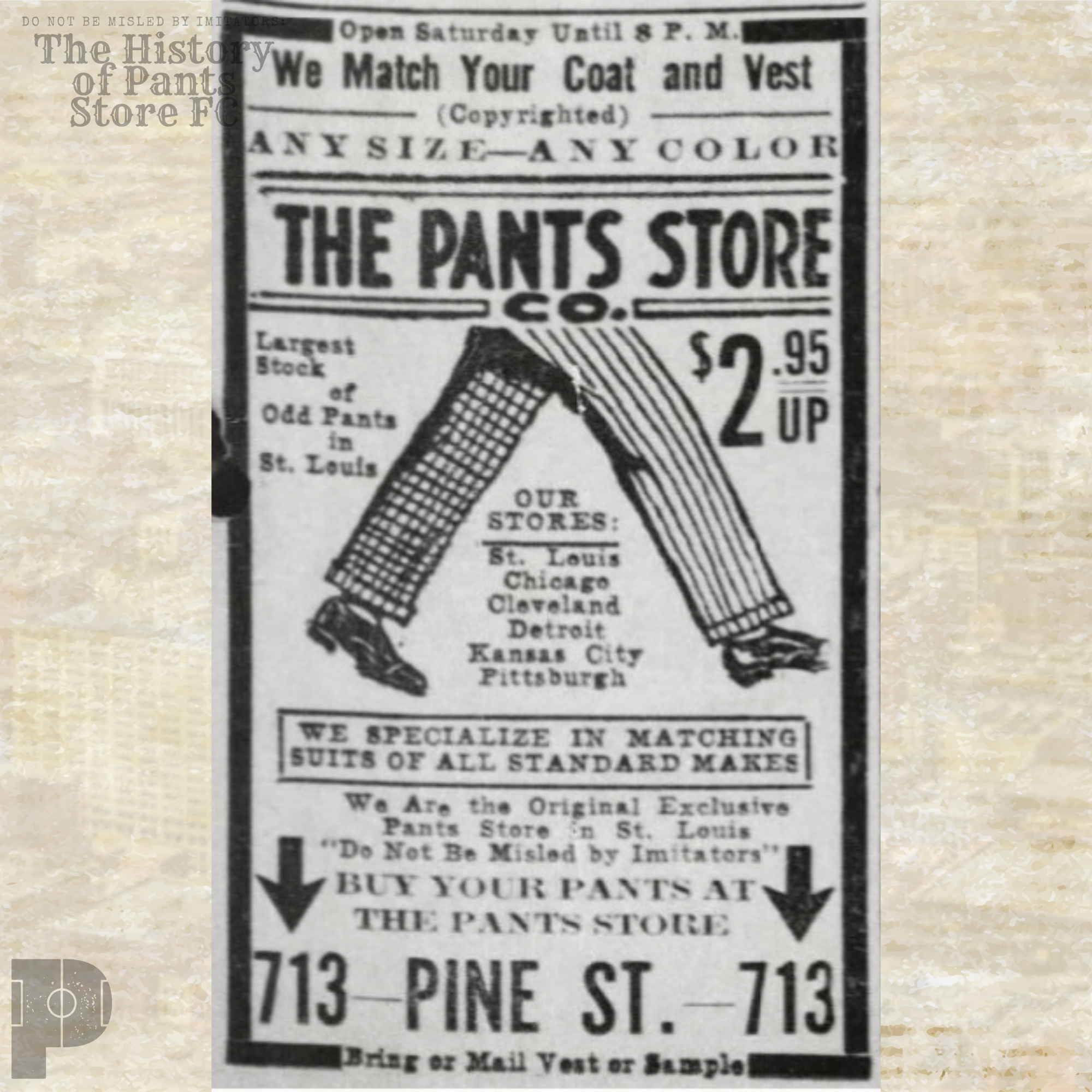
While it is not known how much The Pants Store Company paid for the original sponsorship of Harry Ratican’s eleven, they paid $750 ($14,200 in 2026) for the 1925-26 naming rights. In the offseason “Dutch” Oellerman signed with the Chicago Bricklayers and would no longer be prowling between the posts for the Pants.
For the new season Scullin Steel was sponsored by the Wellston Businessmen’s Association. They would be known as the Wellstons or also the Easton Avenue men. Those readers who might be curious to look for Easton Avenue in Wellston, MO will not find it. Easton Avenue is now known as Dr. Martin Luther King Drive.
Going forward players on all four teams would be paid a set per game salary based on game results. To increase attendance the league instituted a monthly ladies’ day where women could get in free every third Sunday of the month. There was also a push to attract larger crowds by bringing in out-of-town teams for exhibition matches throughout the season as opposed to just during the Christmas break. The league also added a new rule that any players caught smoking on the field in uniform would be subject to a fine. The St. Louis Soccer League was ready to kick off the 1925-26 season.
The second season of Pants Store soccer got off to a considerably better start. Pants Store defeated the Wellstons by a score of 2-1. Schimmel scored the opener and with 12 minutes left to play Brengle headed in the winner. The next week was the same old Pants as they got blanked by Vesper Buick 2-0.
The first two weeks of the SLSL season had all the sportswriters chattering. Across their articles the opinion was unanimous. The quality of play to start the season was not good and except for Vesper Buick the players looked out of shape and unprepared. In response coaches ordered players to report every evening for training. This led to a cheeky headline in the St. Louis Globe-Democrat,
“Soccer Players to Train for Season Already Started.”
With several players, including new goalkeeper Syl LeBaume, out with sickness or injuries, Pants Store dropped a 3-2 decision to Ben Millers. They bounced back the next week with a 1-0 win over Wellston.
The following week saw Pants Store once again use bad field conditions to their advantage. There had been torrential rain Saturday night and by Sunday morning the fields were ankle-deep with mud. This helped Pants Store even the odds against league leading Vesper Buick. They battled back from a 3-1 deficit against the Automen to pull out a 3-3 draw.
As Charles Bartley put it in his game story, “In the opening contest the Pansies showed that they were the better mud horses.”
There was no mud to save the Pants the next two weeks as they lost 3-1 to the Ben Millers and were outscored 4-2 against Wellston. In their final game before Christmas break Pants Store tied Vesper Buick 1-1.
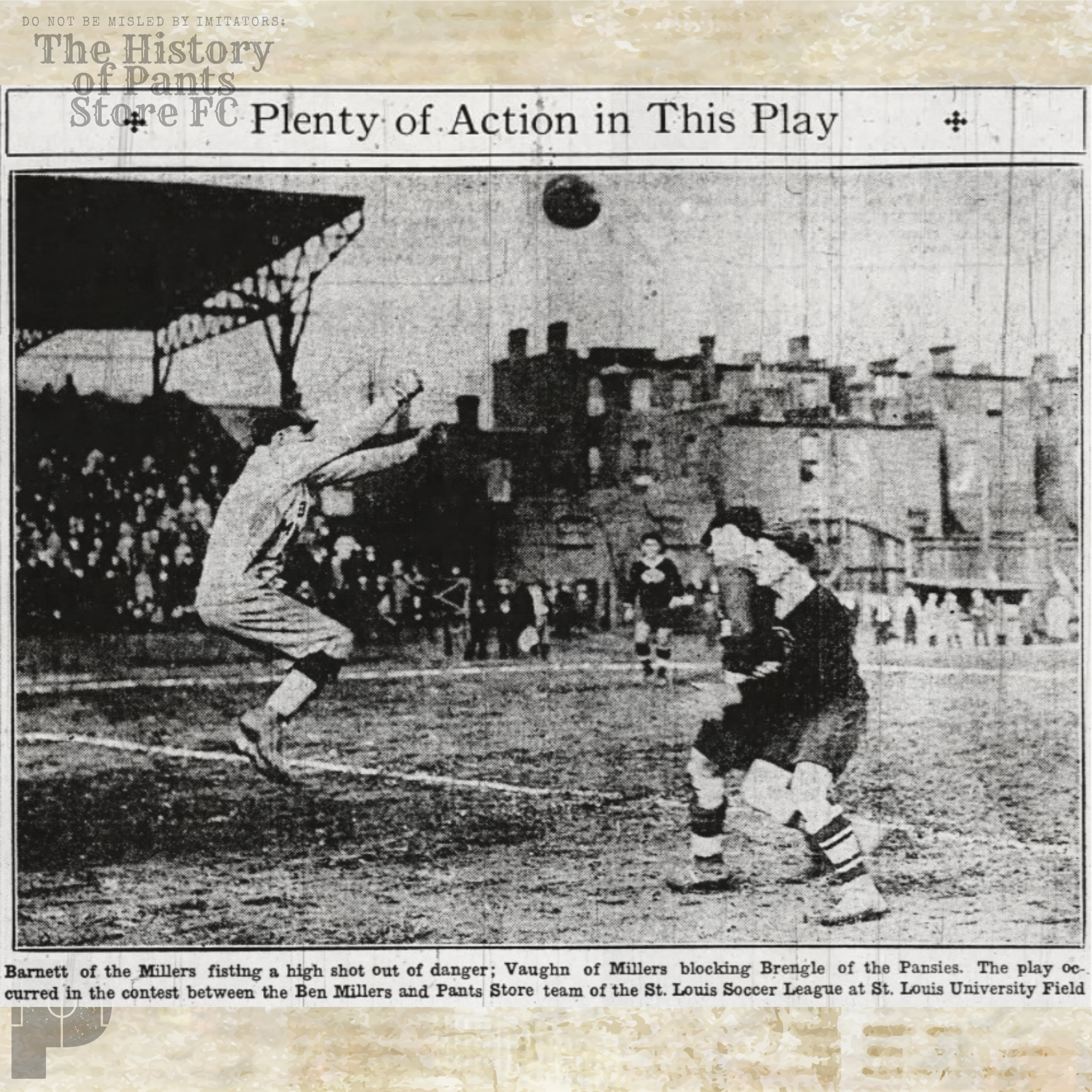
While they certainly weren’t great, Pants Store FC was doing better than the year before. They were also getting a reputation around the league for fast paced play and quality goalkeeping. The forward line led by “Buddy” Brengle (6 goals in 8 games) was clicking, and rookie goalkeeper Syl LeBaume was performing admirably.
Prior to their last game before break Pants Store FC found out their first opponent would be Wellston in the 1926 United States Football Association National Challenge Cup. Readers may be more familiar with the competition by its current name the Lamar Hunt US Open Cup. Pants Store didn’t play in the 1925 iteration of the cup because the St. Louis Soccer League and its East coast counterpart the American Soccer League withdrew from the competition.
Part of the reason the two major professional leagues in America withdrew from the competition was because they did not want to play against lesser teams and they were not making enough profit from the games. Before the 1925-26 season began the USFA caved on both demands. Professional teams would not have to play in the early rounds thereby avoiding weaker opponents. The split of revenue was also altered. Previously the USFA received 15% of the gross (before expenses) gate receipts. In the new agreement USFA would get 15% of the net (after expenses) and the teams would get the remainder. With peace at hand the SLSL was back in the cup.
In the first game after Christmas break Pants Store had another 1-1 tie, this time against the Hatters. Both goals were scored in the final four minutes of the match.
In their first National Challenge Cup game the Pants beat Wellston by a score of 2-1. With goals from Brengle and Ratican. The star of the game was LeBaume, who parried a flurry of shots as the Easton Avenue men looked to avoid elimination at the hands of Pants Store.
John J. Sheridan of the Globe-Democrat was thoroughly impressed, “LeBaume met all demands with cool, calculative success. Leaping and diving, skidding from one end of the goal to the other, he was a real inspiration, so genuine that the Wellston forwards ultimately concluded that ‘it was of no use’.”
The only Wellston goal came on a penalty kick. Pants Store drew Vesper Buick for their next round cup opponent.
Back in league play Pants Store would find themselves facing Wellston yet again. This time they came away with a 4-3 win.
The following week was a return to cup action against Vesper Buick. The Automen ran away with it, crushing Pants Store 6-2. At the end of the first half the Buicks led 3-1 and it was reported in the Globe-Democrat that many thought Pants Store might come back because they would be “kicking downhill.” This is not in the modern sense of the term where a team might be said to be “running downhill” because they are playing particularly well, St. Louis University Field was just slanted. Unfortunately, it did not help. Thus, Pants Store’s participation in the National Challenge Cup ended.
With only league play to focus on the next week Pants Store tied Vesper Buick 3-3. If Harry Ratican had a nickel for every time his team played a league game against an opponent they had just played in the cup, he’d have two nickels. Which isn’t a lot, but it’s weird that it happened twice. The Pants had a chance for victory, but a goal line save by Vesper defenseman Scott stopped them. The save came on what was described as a “freak shot” by Pants Store’s Al McHenry.
Here’s how McSkimming described it, “[McHenry] had his back to the goal when he hooked a shot over his head, just 10 feet from the goal. Scott, hampered by opponents, leaped into the air and headed the ball over the cross bar for a corner kick.”
The next week Pants Store was pantsed by Ben Millers 8-2. Jimmy Dunn scored five goals for the Hatters. As the St. Louis Star put it, “Jimmy Dunn ran amuck and scored goals from every angle of the field.”
The following game wasn’t much better, Pants Store lost 5-2 against Wellston.
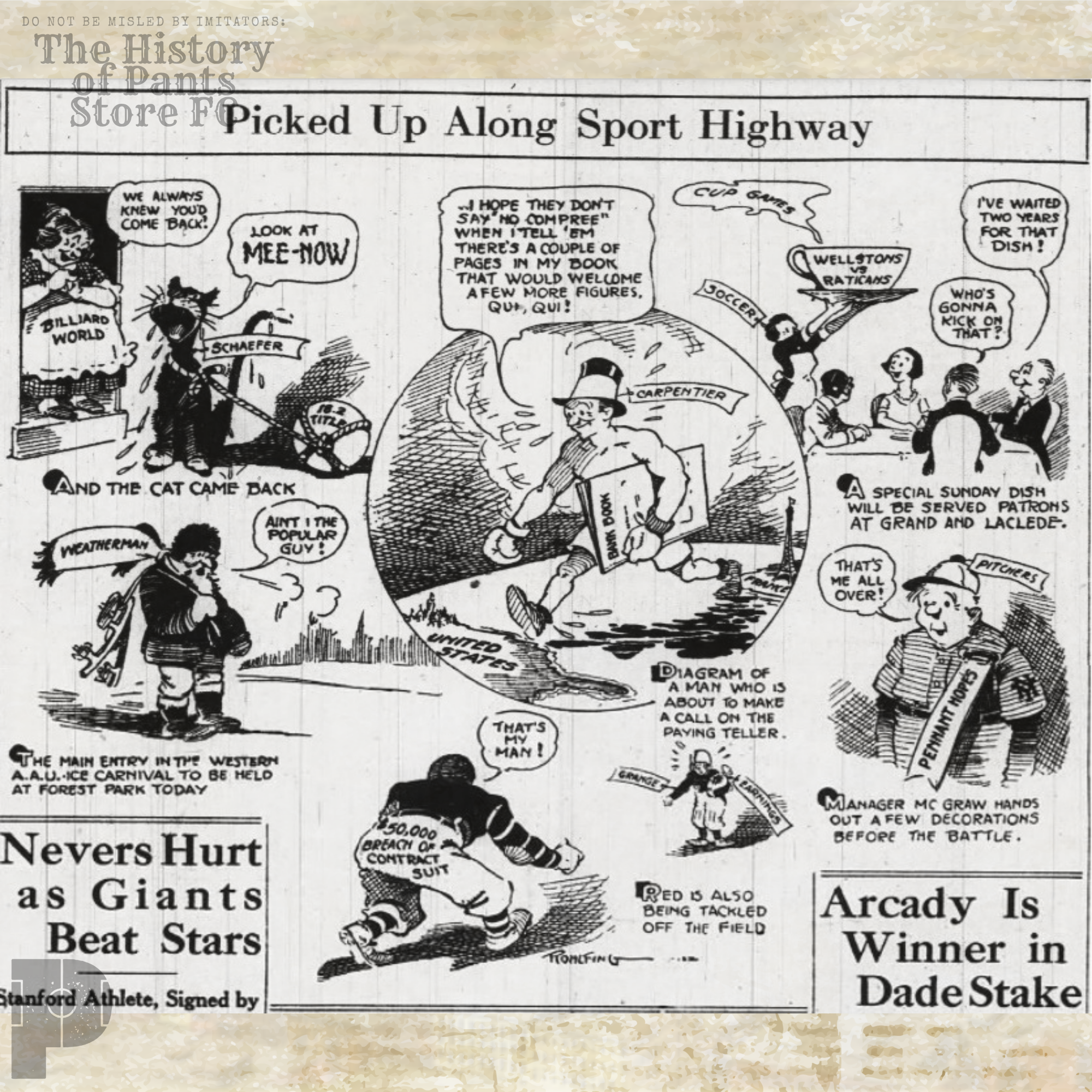
As they approached the final game of the season Pants Store FC found themselves in a familiar position, the role of spoilers. Vesper Buick and Ben Miller were tied for first with identical records of 6 Wins 3 Losses 3 Draws. Pants Store would play Vesper in the final game of the season with a chance to rob the Automen of a title after Vesper ran Pants Store out of the Challenge Cup. The previous time Pants Store FC had a chance to be spoilers they blew it 3-1.
This time they won.
By a score of 3-2 Pants Store defeated Vesper Buick. Ratican, Brengle, and Bochnicek contributed goals. The Globe-Democrat claimed that LeBaume made at least a half-dozen saves on close range shots in the second half to secure the victory. All the sportswriters agreed it was the hardest fought game of the whole season.
Pants Store FC finished in third place with a record of 4 Wins 5 Losses 4 Draws and a -6 Goal Differential.
Over the summer The Pants Store Company dropped their sponsorship. Pants Store FC was no more. The team would go on for a few more years with and without sponsors and with a change in ownership. But no longer would they charge forward carrying the banner of quality pants at affordable prices.
In 2026 disagreements over pay and insurance, among other things, would nearly lead to a strike in the United Soccer League Championship. In 2024 Major League Soccer attempted to withdraw from the US Open Cup and eventually limited their participation partly because of opponent quality and an inability to turn profits on the games. Only recently declaring they would fully return for the 2027 iteration of the historic tournament. Check any message board, social media site, or op-ed today and you’ll surely see comparisons between America and Europe, handwringing about attendance, and lamenting about commercialization of the sport. One-hundred years ago a team called Pants Store fought these same battles.
The story of American soccer is still being written. Some teams write chapters, others write paragraphs, and many write just a sentence. But they all write something. The history of the game isn’t only the Cosmos, Bethlehem Steel and Inter Miami. It’s also less heralded teams like magicJack, The Caribous of Colorado, and Pants Store FC. Those teams mattered. Their story is our story. It’s the story of the beautiful game in this country with all its glory and all its blemishes. It’s the story of American soccer, and when it comes to American soccer.
Do not be misled by imitators.
by Tim Thomas