The Protagonist Zine - Issue Three, “Legends of St. Louis”
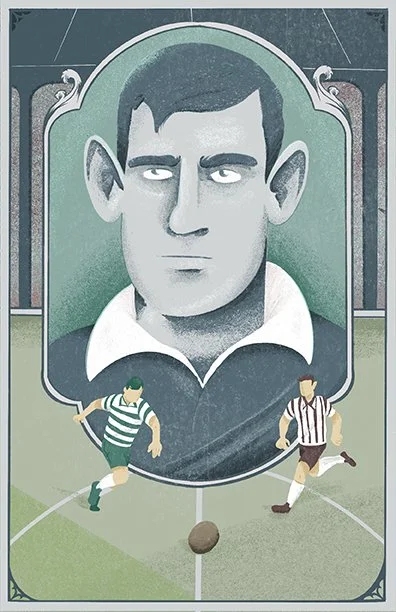
Original Art by Rob Arbrister
Tate Brady - The Man Who Should be King
by Dan Creel
For most fans of soccer in the U.S., the history of sport probably begins in the 1990s. It's the decade of the US World Cup in 1994, the first women’s World Cup titles, and the launch of Major League Soccer. Some others may likely have heard of Pele and NASL but little more than that.
This is not an indictment of some inherent near-sightedness of American soccer fans. It’s actually much more an outcome of the historically poor stewardship of the game from the leaders of US soccer itself. A generational inferiority complex and constant infighting among the stewards of soccer have torn massive holes into the fabric of our country’s soccer history.
As modern soccer historians have begun piecing this vibrant two-century-old quilt back together, the sheer scope of America’s connection to soccer is impressive to behold. Important events and people involved in the sport, long-forgotten or thought to be myth, have come back into sharp focus.
One of these hugely important soccer names is likely unknown to those reading this article. He would be a St. Louis and national sporting legend if he took part in one of the other big sports in the U.S. But, due to the vagaries of a history that has drifted from public consciousness, it should be a relatively well-known name to the average soccer fan. A no-doubt first ballot hall of famer given his career. But, for most, this will be a new story.
Arthur James Brady was born in Hannibal, Missouri on December 8, 1890. The middle child of five, Arthur’s parents, Thomas Brady and Mary Conklin, were both second generation Irish-Americans. Soon after Arthur’s birth, the Bradys would move to St. Louis for Thomas’ job as a railroad conductor working on a train from St. Louis to Denver.
The family would move into the upper-middle-class Academy neighborhood south of Sherman Park near the intersection of Kingshighway Boulevard and Easton Avenue (now Dr. Martin Luther King, Jr. Drive). The Bradys were solidly middle-class and were well-off enough to have a live-in servant to help take care of the couple’s five young children. All of the Brady children would attend school. After finishing, Arthur worked for the railroad too as a stenographer.
But Arthur wasn’t just a bookish young adult. He was also a top-notch all-around athlete. Nicknamed “Tate”, a moniker that would become his everyday name, Arthur Brady was an elite baseball pitcher and infielder during the summers and a top-tier defensive soccer player during the fall through spring season.
Tate would begin playing soccer as a youth in St. Mark’s parish before joining the parish’s amateur club team as a teenager. He would spend those later years playing for the club in the St. Louis Amateur League. That league played most of its matches on the campus of Christian Brothers College of which Brady was an alumnus. Tate would get a taste of semi-professional soccer when St. Mark’s would move from the St. Louis Amateur League into the higher-level St. Louis Soccer League for the 1908-09 season.
We should pause here from Tate Brady’s story to provide some background to how soccer was structured in St. Louis during the first half of the 20th century. This is not only important for an understanding about what was going on with St. Mark’s in their 1908-09 season, it’s also vital for an understanding in Tate’s story later on (and the story of St. Louis soccer).
Soccer’s growth in St. Louis took a unique path. First off, it may not be anything special as you read this in the 21st century, but when Tate Brady was playing at the turn of the 20th century, St. Louis soccer was being played by a majority native-born population.
At that point in history, in the soccer hotspots around the U.S. you’d see the game usually played at the higher levels mostly by immigrant players. In St. Louis, though, soccer players were usually second generation Americans at least.
Even more unique was how the leagues themselves were structured in St. Louis. The league set-up most soccer fans are accustomed to is a group of clubs who each play home matches at their own stadium and then travel to play away matches at their opponent’s stadium.
In St. Louis, though, the park was the focal point of a league. A group of teams would lease the use of a neighborhood park and every week play against other teams on that ground. This organically led to leagues playing double-headers each Saturday or Sunday afternoon. Which then organically followed that, before the advent of artificial lights, it made sense to just have four teams in each league which played those double-headers each weekend.
Thus developed the St. Louis league structure of a city with many, many four-team leagues playing two-games each Saturday or Sunday afternoon. While there were leagues in the city with more than four teams, four was the norm.
One final difference that evolved due to this setup was that soccer matches in St. Louis during the first half of the 1900s were only 60 minutes long with a 5-minute halftime. This was another outcome of needing to make sure that the second match of each double-header would finish before darkness stopped the action. In fact, when Tate Brady was playing in the St. Louis Amateur League, the games were only 50 minutes long having 25-minute halves.
Soccer leagues in the city were formed on a semi-permanent basis. Every season the leaders of each league would get together in a partnership to lease a specific park. It was rare to have a permanently organized league as a formal entity which would continue during offseasons.
A last thing to note for this short jaunt into the format of early 20th century soccer in St. Louis is the connection between team names and their sponsors. An aspect of the game in St. Louis which has complicated the historical record is the misunderstanding of an ongoing team with the often changing nature of that team’s name.
It’s a common misconception that historic teams in St. Louis disbanded when the name of a certain team stopped appearing in the standings of a league. St. Louis teams depended on their sponsors to field the players, pay for the kits, and other incidentals. Like Little League baseball, it was extremely common in St. Louis for a soccer team to take on the name of the person, business, or organization that sponsored them.
A team could obviously change sponsors during the off-season. Doing so would usually lead the team to change its name even though the team never disbanded. This is yet another important fact to hold concerning Tate Brady’s career.
Entering the 1908-09 St. Louis soccer season, the St. Louis Soccer Football League was the major league in the city. The StLSFL launched the prior season after St. Louis went the entire 1906-07 season without a professional league for the first time in well over a decade.
As befitted the top league in St. Louis, the StLSFL played its matches in a major league baseball park. The league would lease Sportsman’s Park, home of the St. Louis Browns, each soccer season. The venue was commonly called Athletic Park when not being used for baseball.
The StLSFL achieved a major coup for its second season when the St. Leo’s club joined the league. When it joined the top league, St. Leo’s was the St. Louis city soccer champions for five years running and was often thought as the best soccer team in the Western U.S.
Sensing the re-emerging popularity of soccer in St. Louis, Thomas W. Cahill, one of the great builders of American soccer, decided to form a second professional soccer league in the city. Cahill had been an organizer of soccer clubs and leagues at the turn of the century but founded the Southwestern Illinois Inter-City Baseball League in 1906 as interest in soccer took a downturn. Nicknamed the “Trolley League”, it was a semi-professional minor league which played at Kulage’s Park located on the border of the Penrose and O’Fallon neighborhoods.
Simply called the St. Louis Soccer League, Cahill’s organization served as a lower-level professional alternative to the StLFL. St. Mark’s, managed by George Tivy, moved from the St. Louis Amateur Soccer League to take part in Cahill’s new semipro league.
Tate Brady, just 17-years-old, started every match of the 12-game schedule for St. Mark’s. He began the season in his usual forward position and scored a goal in the team’s first match. St. Mark’s won their initial match but ended up struggling against semi-pro competition. Over the season, Tate moved back from forward to halfback then finally to fullback. It would be an important experience for Brady’s future soccer career.
While St. Mark’s would fall out of the professional soccer ranks after one season, Tate Brady returned to Kulage’s Park for the 1909-10 season starring at halfback for the Duwell A.C. team. Tom Cahill and Henry Kulage, owner of the ballpark, organized the Association Football League of St. Louis to play professional soccer at the venue for a second season.
A month after the soccer season ended, Tom Cahill was transferred by his employer, the A.G. Spalding & Brothers sporting goods company, from St. Louis to New York City. Tate Brady would also make a big change that offseason, jumping to the major league St. Louis Soccer Football League.
The StLSFL added the Columbus Club team to its four-team roster for the 1910-11 season. The team was managed by John “King” Finnegan and was composed of players who were members of the Knights of Columbus. At the time, Finnegan was considered to be on the short list of best soccer players to ever come out of St. Louis.
King Finnegan would lead his team as captain from his center halfback position. Tate Brady started all right fullback that year as the Columbus Club came in second while St. Leo’s won its third straight StLSFL title.
Finnegan would again start the 1911-12 season as captain of the Columbus Club. But, four games in, he retired as a player and handed the captain’s title over to the 21-year-old Tate Brady. Newspaper reports at the time noted that Brady was a vastly improved player at fullback. It was during this season that Brady solidified his position as one of the top soccer players in St. Louis.
The 1912-13 season would be a watershed moment in the history of St. Louis soccer. In the offseason prior, tensions arose between the four club owners. Just weeks before the season began, the owners could not agree on a venue. Bill Klosterman of the mighty St. Leo’s and Willie Foley of the Innisfails wanted to stay at Athletic Park. King Finnegan and Ed Houlihan of the Business Men’s A.C. wanted to move to the home of the St. Louis Cardinals, the “new” Sportsman’s Park (aka League Park).
The meeting went so badly that each side announced they were planning on launching competing four-team leagues for the 1912-13 season. But, league officials came to an understanding and signed another lease agreement with Tim Cavanaugh, owner of Athletic Park, to use that venue for a sixth straight season.
That season, King Finnegan also signed Willie Brady, Tate’s younger brother, to the Columbus Club. Willie helped St. Mark’s to win the prior season’s St. Louis Amateur Soccer League title and would become the regular starter at inside left forward for Columbus Club.
The St. Louis Soccer Football League had contracted two eastern soccer clubs to play holiday matches in St. Louis: Howard & Bullough from Pawtucket and West Hudson from Harrison, New Jersey. The latter team was considered by many to be the best in the country at that time having just won both the National Association Football League (the top league on the east coast) and the American Football Association Cup. While the schedule called for both east coast teams to play a series of games against the four StLSFL clubs, the team with the best record in the first half of the StLSFL season, would get the honor of playing West Hudson on Christmas Day and Howard & Bullough on New Year’s Day.
Willie Foley’s Innisfails won that honor. But his team was ravaged by injuries in the weeks leading up to the Christmas day match. Understanding the strength of the West Hudson team, King Finnegan lent Tate Brady to Foley to help defend against the New Jersey players.
West Hudson outclassed the Innisfails and easily beat them 4-1 before a crowd of 5,000 at new Sportsman’s Park. The star of the Innisfails was Tate Brady. Newspaper accounts said that he alone kept West Hudson from scoring even more goals. As the game wore on, the Innisfails would direct more of the game towards Brady in order to keep them competitive against West Hudson.
While the 1911-12 St. Louis holiday friendlies were a success for both Brady and the city of St. Louis, they had an unforeseen negative impact on the StLSFL. The holiday games had been contracted for new Sportsman’s Park before the StLSFL decided on contracting with Tim Cavanaugh’s Athletic Park for the league season itself.
Upset that the league had played the holiday games at new Sportsman’s Park, Cavanaugh told the StLSFL that they could no longer play league matches at Athletic Park. The league had a contract for the park through the first Sunday of March, though. And, the park owner eventually conceded, likely because he would lose the $35 for each game the StLSFL played there.
The simmering tensions among the leaders of the StLSFL finally reached the boiling point when league play resumed. Halfway through the season, St. Leo’s was on track for a fourth straight major league title. The team was also the current holder of the St. Louis city championship (by beating Willie Brady’s St. Mark’s team 10-1 the previous March) and the state soccer championship having defeated the top teams from other cities in the surrounding states. St. Leo’s was also considered the undisputed champions of the West having beaten Woodland of the Chicago leagues 8-1 on Christmas Day in 1910 to solidify the title.
After a week’s postponement due to wet conditions, the StLSFL played their first doubleheader in 1913 on Sunday, January 19. A crowd of 2707 at Athletic Park saw the match between Innisfails and St. Leo’s devolve into a fight. The match was halted in the second half. Following a discussion with St. Leo’s manager Billy Klosterman, referee Paul McSweeney threw his whistle over the Athletic Park fence and quit the league.
Officials of the St. Louis Soccer Football League convened two days later where Klosterman formally resigned as a member of the league. League officials refused to accept McSweeney’s resignation as league referee. Newspaper reports stated that league officials claimed Klosterman quit so he could arrange an eastern trip for his St. Leo’s team.
Following the loss of St. Leo’s, the StLSFL added Compton Hill A.C. as a new fourth team. The league abandoned its current schedule and played a new, shortened spring-only season to crown the league champions. Innisfails would win the six-week competition.
Chaos reigned as St. Louis Soccer Football League officials met to organize the 1913-14 season. In the second week of September, Billy Klosterman reorganized the league under the direction of Tim Cavanaugh, owner of Athletic Park. Along with Mike Whelan, backer of the Innisfails club, the new league’s leadership installed Winton E. Barker, former president of the various Kulage’s Park leagues, as president of the St. Louis Soccer Football League. They added two new teams including a new one managed by Pete Ratican under the sponsorship of the Ben Miller Hat Company.
The following week, the other leaders of the St. Louis Soccer Football League, including president Dr. Alexander Murray, signed a contract to play at Robison Field. King Finnegan’s Columbus Club and Ed Houlihan’s Business Men’s A.C. continued as members of the returning StLSFL. The full roster of manager Willie Foley’s Innisfails players also attended, showing support to their manager. Following that meeting, Mike Whelan left Klosterman’s StLSFL and returned to Finnegan’s StLSFL to back his Innisfails players and manager.
The St. Louis Soccer Wars had begun in earnest. A factor to note in the skirmish was that Klosterman’s league had affiliated itself with the newly-organized U.S. Football Association. Now called USSF, the USFA had formed in April of 1913 in order to become FIFA’s member association for the United States. The USFA received provisional sanctioning in early August of that year, beating the old American Football Association for that honor.
Even though the USFA was now FIFA’s official designate, its control over the U.S. soccer landscape was still tenuous. Tom Cahill’s USFA wanted the St. Louis Soccer Football League as a feather in its cap, and Klosterman and Barker gave the USFA a St. Louis Soccer Football League.
In mid-August, Klosterman approached Tate Brady with a proposition to join St. Leo’s but Brady stayed loyal to King Finnegan. On New Year’s Day 1914, the Fall River Rovers visited St. Louis to play Columbus Club at Robison Field. The Rovers were one of the best teams in the country at that time and beat the Columbus Club 3-1 before 1279 at Robison Field. Again, Tate Brady was the star St. Louis player against a stronger eastern team. Newspaper reports noted that Fall River would have run up the score even more if not for Brady’s play.
Tate Brady would bring the first St. Louis Soccer Football League title (Robison Field edition) to the Columbus Club that season. That summer, Tate would take over as player-manager of the Wabada baseball team of the Trolley League. The team was made up of neighborhood teenagers, including Tate’s younger brother Cliff, who had been playing together since its founding in 1910. At 24, Tate was the only player over 19 years of age. The Wabadas would have an outstanding season under Brady’s helm winning the Interstate League. Tate himself drove in the game-winning run for the Wabadas off a single in the twelfth inning of the final match.
The 1913-14 professional soccer season had been a disaster. Both leagues suffered financial setbacks and the competition itself was lackluster due to each league having two strong and two weak teams. Klosterman’s league dropped the St. Louis Soccer Football League moniker and officially renamed itself as the Federal Park Soccer League for the 1914-15 season.
Almost immediately after the season started, peace talks began under direction of the USFA. By the start of the 1914-15 soccer season, the USFA had solidified its status as the controlling organization for soccer in the U.S. While the Federal Park League was formally sanctioned by the USFA, the StLSFL had the better stadium and its attendance was double that of its competitor.
Following numerous meetings and discussions, the StLSFL applied for admission to the USFA in early December of 1914. Discussions about the application and what the sport would look like in St. Louis followed. During this uncertain time, Tate Brady would bring a second straight title to the Columbus Club.
Finally, in late March of 1915, peace was brokered. Bill Klosterman agreed to quit as manager of St. Leo’s. That opening allowed King Finnegan to pass on managerial duties of the Columbus Club to his captain, Tate Brady. The two big personalities of Klosterman and Finnegan decided to step away from the game both for personal reasons and in order to help bring a peaceful conclusion to the St. Louis Soccer War. St. Leo’s and Columbus Club plus the strongest other two teams of the competing professional leagues, Willie Foley’s Innisfails and Pete Ratican’s Ben Millers, agreed to form a new four-club professional league to start that fall.
A month after the peace talks, the soccer leaders came together to formally organize the new competition. Winton E. Barker was elected president of the new St. Louis Soccer League by a unanimous vote of the four managers. Tom Cahill, secretary of the USFA, attended the meeting signifying the importance of the occasion and burying the hatchet of personal animosities between some of the league officials and himself.
Another pause from Tate Brady’s story is helpful at this point to provide background on how the St. Louis Soccer League itself operated. Again, it is important context for Brady’s career and accomplishments.
The StLSL’s inaugural season was a success. Competition on the field was back to an elite level and attendances approached 3,000 at Robison Field. Both of these metrics were a massive improvement over the prior Soccer Wars years.
Because of this success, league officials took the big step of making the organization a permanent business entity. Officially called The Soccer and Exhibition Company of St. Louis, the league was owned by seven or eight individuals. Four of those were the franchise owners of the four teams. The remainder were the league executives. Winton Barker was president of the StLSL for most of its existence and Phil Riley was its long-time Treasurer. The vice president and secretary positions rotated often over time.
It’s interesting to note that the St. Louis Soccer League operated in many important ways as a proto-MLS. The owners of the clubs were also owners of the league. Team managers would individually acquire players but the players signed contracts with the league rather than the individual team.
The manager of each team in the league was usually, but not always, also the franchise owner of that team. When the StLSL was launched, it was extremely rare for a soccer team to have what we now know as a head coach. Those duties usually fell to the captain. The manager’s role was more of what we would call a general manager (or technical director).
So, at the advent of the StLSL, Tate Brady was captain of his team. That meant he was also akin to the head coach on game days. He was also the general manager and owned the team’s franchise in the StLSL. Finally, because he was a franchise owner, that meant he was also a part-owner of the league itself.
Keep all of that in mind as Brady’s soccer career unfolds.
Tate Brady’s transition from all-star captain to captain-manager-owner was a bumpy one. Team sponsorships made a big difference to the competitive nature of the sponsored team. The dollar amount paid gave managers more flexibility to put a better roster together. But the indirect benefits that a sponsor could bring compounded that. A sponsor could provide additional resources like kits and equipment, free training facilities, or, most importantly, employment for players.
During the offseason before the inaugural 1915-16 St. Louis Soccer League season, the Knights of Columbus decided not to back Columbus Club any longer. Brady found a new sponsor and Columbus Club became the Missouri Naval Reserves.
Brady’s Missouri Naval Reserves squad struggled in its first three seasons of play in the StLSL.The Reserves would find themselves at the bottom or near bottom of the standings each season. Brady’s non-soccer career may also have been a factor in these struggles. In 1915, along with taking over a soccer club and becoming co-owner of a soccer league, he began working for the Bureau of Internal Revenue (later renamed the Internal Revenue Service).
Pete Ratican’s Ben Miller squad won the first three StLSL league titles. The initial squad, led by center forward Harry Ratican, Pete’s brother, keeper Honus King, and inside left Hap Marre, was a truly dominant side and likely the best team in the West that season.
The fortunes of Tate Brady, his team, and soccer history would change dramatically during the offseason prior to the 1918-19 St. Louis Soccer League season. With the Great War over, a shift towards industrialization had a massive impact on American society. The sport of soccer was not immune from those changes.
In both the East and West, company teams began to dominate the soccer landscape. In St. Louis, that was seen when both the Missouri Naval Reserves and St. Leo’s dropped out as sponsors of their professional soccer teams.
A day before the season started, Harry McCarthy, manager of St. Leo’s, announced that they have found a new sponsor (and name) in the St. Louis Screw Company. The rising cost of material and equipment had made it difficult to field a competitive team under the financial sponsorship of St. Leo’s.
Tate Brady found an even better sponsor in the Scullin Steel Co. The company was founded in 1899 manufacturing industrial and architectural steel for a number of uses, especially castings for railroad cars. During World Wars I and II, Scullin Steel manufactured materials for the U.S. military including munitions and armor for tanks and other military vehicles.
The Missouri Naval Reserves team became the Scullin Steel Co. team. And, with the additional resources available, Tate Brady’s club broke the title streak of the Ben Miller club. The Scullins would win the St. Louis Soccer League title on the final Sunday of the season by beating Innisfail’s 3-2 at Cardinal Field.
Attendance grew year on year over the initial seasons of the St. Louis Soccer League and the crowd at Cardinal Field (the re-named Robison Field) for that final match was estimated at 3,000. With the Scullins and Innisfails tied at the top of the standings going into the last match, the league decided to institute extra time if the match ended tied in regulation.
The match on March 30, 1919 did, in fact, end the regulation 60 minutes in a 1-1 draw. That necessitated two 15-minute extra periods. Cliff Brady scored for Scullin Steel in the first extra period.
Cliff was Tate and Willie’s younger brother. A top baseball prospect, Cliff had joined the Columbus Club team during the final season of the St. Louis Soccer Wars and became the team’s top goal scoring threat beginning with the initial Scullin Steel season.
Dutch Schweppe tied the score when he sent a goal home for Innisfail’s in the second extra period. But, Jimmy Nolan scored the game-winner at the end of the 15 minute period to clinch the title for Scullin Steel. It was Tate Brady’s first title as a manager and owner.
The 1919-20 St. Louis Soccer League season would be another watershed moment in U.S. soccer history. That season, league officials decided to enter its clubs into the National Challenge Cup (now called the Lamar Hunt U.S. Open Cup). It was the first time St. Louis would be represented in the U.S. soccer championship.
The StLSL teams would receive a bye in the First Round of the NCC. The professional sides used their double-header on November 23, 1919 to count as both league matches and Second Round cup matches.
The inclusion of St. Louis teams into the NCC raised the overall soccer excitement in St. Louis to an even higher level. A crowd of 4,000 at Cardinal Field saw Ben Miller crush Innisfail’s 6-1 in the opener and Scullin Steel beat St. Louis Screw 3-1 in the second match. The Third Round match was held on the league’s scheduled double-header on Christmas Day. Ben Miller would edge Scullin Steel 2-1 to advance as the Missouri champs into the Fourth Round of the cup.
Ben Miller would beat McKeesport National Tube from Pennsylvania in the Fourth Round to advance to the NCC’s Western Semifinal. The team was also headed for another StLSL title but struggled down the stretch going winless in its last five league matches.
For a second straight year the St. Louis Soccer League would come down to a final match. This time a playoff between Ben Miller and Innisfails. The match again went into extra time and again Innisfail lost late when Jerry Kavanaugh, a sub for Rube Potee, scored the game winner in the last minute of extra time. It would be the fourth league title for Pete Ratican’s Ben Miller side in the league’s first four seasons.
Ben Miller would then sweep the end of the spring season for even more titles. The team beat the (now-amateur) St. Leo’s in the St. Louis city championship, Olympia of Cicero, Illinois in the NCC Western Semifinals, and Packard of Detroit in the Western Finals.
The National Challenge Cup Grand Final was held on May 9, 1920 at High School Field (aka Federal League Park) in St. Louis. A massive crowd of 10,000 came out to see Ben Miller beat the professional Fore River F.C. of Quincy, Massachusetts 2-1.
It was the first time a team outside of the northeast U.S. had won the cup. It was also the first time the National Challenge Cup was won by an all American-born team.
During that offseason, Brady would be part of the third international tour of U.S. soccer players sanctioned by the U.S.F.A. In 1916 Thomas Cahill, Tate Brady’s old compatriot, organized and managed a team of U.S. soccer players to tour Sweden. Two of those matches are now formally recognized as the first two official matches of the U.S. Men’s National Team. Cahill would organize and manage a second international tour in 1919 when he took the great Bethlehem Steel F.C. team back to Sweden that summer.
The following summer it was St. Louis’ turn. Cahill organized an All St. Louis team which again went on tour in Sweden. The 18-player team included 12 St. Louis Soccer League players plus six players from East Coast leagues. The St. Louis native, Harry Ratican, was voted by the team as captain. Tate Brady was also a member of the touring squad and, while not the team’s captain, was considered to be in charge of the 12 StLSL players.
The St. Louis team set sail in early July of 1920 and played 14 matches, mostly in Stockholm, during August and September of that year. It was a successful tour for the St. Louis team and St. Louis soccer. Like the Bethlehem Steel F.C. before them, the St. Louis team ended up with a record of seven wins and two draws over the 14-game tour.
The success of Ben Miller in winning the 1920 National Challenge Cup showed that St. Louis could compete on the national soccer stage. While Pete Ratican’s side had shown the way. Tate Brady would use that experience as a springboard for a historic run.
An unfortunate occurance added another profound change to the St. Louis soccer landscape. In the middle of the 1920-21 season, Pete Ratican fell ill and eventually had to undergo brain surgery. Hap Marre would step up as acting manager but Ratican was never able to return to active management of his club. The fortunes of the Ben Miller team would take a downturn due to its leader’s serious health issues and subsequent death.
That season, Tate Brady’s Scullin Steel side became the dominant team in the St. Louis Soccer League. Still led on the field by Tate himself, the Scullins also included stars such as keeper Dutch Oellerman, inside left Dike Brannigan, outside left Emmett Mulvey, along with the continued goal scoring of inside right Cliff Brady.
Like Ben Miller before them, the Scullins would win the league title and make a run to the Grand Final of the National Challenge Cup. In that match, the Scullins faced Robins Dry Dock of the professional National Association Football League.
While the Robins were based out of Brooklyn, New York, the Grand Final was played at a neutral site - the venerable Athletic Field in Fall River, Massachusetts. A crowd of nearly 6,000 saw the Scullins’ cup run end as Robins Dry Dock beat the St. Louis Soccer League side 4-2. Although he did not score a goal, Harry Ratican was a member of the Robins side that beat Scullins.
The following season would be Tate Brady’s greatest triumph. Scullins would win another league title. He would also lead his squad to a second straight National Challenge Cup Grand Final.
The Scullins hosted Todd Shipyards F.C. on March 19, 1922. The Brooklyn-based Todd Shipyards was a member of the newly-formed American Soccer League, the U.S.F.A.’s first real attempt at a major professional soccer league.
Todd Shipyards was actually the Robins Dry Dock professional side merged with the Tebo Yacht Basin amateur team under one company team umbrella. The Todd Shipyards roster was stacked with top players and included future Hall of Famers Johnny McGuire and Pete Renzulli. Harry Ratican himself was again opposing his hometown side hoping to bring a second straight National Challenge Cup to Brooklyn.
A crowd of nearly 8,600 packed High School Field to see the hometown Scullin Steel beat the major league Todd Shipyards 3-2. The Scullins would go down two goals early but a goal by Cliff Brady pulled one back before half time. Elmer Schwarz, the Scullins’ center forward, would score a brace in the second half to bring the title back to St. Louis.
Captain-manager-owner Tate Brady added the U.S. soccer championship to his packed trophy case.
The 1922-23 soccer season was massive in terms of the popularity of the sport. In St. Louis the professional StLSL was drawing over 3,000 for its Sunday doubleheaders at High School Field. The league’s National Challenge Cup games were drawing over 5,000.
That season, the Sculllins made another run for a league title as well as back-to-back NCC championships. Tate Brady’s side faced Bricklayers F.C. of Chicago in the Western Semifinal of the national cup. A crowd of nearly 6700 at High School Field saw Scullin Steel defeat the Bricklayers 3-1 in extra time. The Scullins would then beat Arden F.C. of Pennsylvania in the Western Final before nearly 6600 on the same pitch.
Things would take a turn for the worse after that match. Tate Brady’s team would only win one of their final four league matches down the stretch. That gave the league title to the former St. Louis Screw team, renamed Vesper-Buick for the 1922-23 season after a change in sponsors.
The 1923 National Challenge Cup Grand Final was held on April 1, 1923 at Harrison Field in Harrison, New Jersey. The Scullins would face Paterson F.C. a mid-table American Soccer League team in the match.
An estimated crowd of 16,000 was in attendance and saw a true soccer battle. The game ended tied in regulation. Neither team could score in the two 15-minute extra periods and the final ended in a 2-2 draw.
The U.S.F.A. cup committee quickly met to decide the time and place for a playoff. Controversy arose when Adolph Buslik, owner of the Paterson club, requested a delay of when the playoff would be held. Tate Brady had already informed the committee that, because of the demand of professional baseball on a number of his players, the Scullins would not be able to put on a competitive team beyond the following Sunday if the playoff was again held on the East Coast.
The cup committee acceded to Buslik’s refusal to play the playoff match in St. Louis and scheduled the game back at Harrison Field. Brady formally forfeited the title at the committee meeting and the U.S.F.A. awarded the 1923 National Challenge Cup to Paterson F.C.
It was a bitter pill to swallow for Brady, the Scullins team, and the St. Louis Soccer League officials. But, Tate Brady had led a team to three straight National Challenge Cup finals. That put Brady and his Scullins side on the level of the great Bethlehem Steel and Fall River Rovers team which made similar runs.
In 1923 Tate Brady would put his professional career on hold to devote himself entirely to the St. Louis Soccer League and his own team. But Brady’s teams would not win another title for a long while after that 1923 run to the NCC finals. Ben Miller himself would purchase the former Innisfails franchise (which had gone through a couple of name changes before) and the new Ben Miller team would win three straight league titles. That Ben Miller squad made a run to the 1925-26 NCC Grand Final but was crushed 7-2 by the ASL’s Bethlehem Steel at Ebbets Field in Brooklyn.
That same season Tate Brady retired as an active player. After 15 years, he was considered one of the greatest fullbacks in the country. He continued as owner and manager of his St. Louis Soccer League franchise and was elected as vice president of the league. Scullin Steel also dropped its sponsorship of his club. Brady found new sponsors in the Wellston Business Men’s League.
Brady’s Wellston F.C. struggled over its three years with that sponsorship and achieved little. In 1928-29, the StLSL’s Madison Kennel Club team (the former Vesper-Buick team which had also gone through a couple of name changes) was the first league club to make it to the NCC Grand Final since the Ben Millers did it in 1926. But, Madison Kennel suffered the same fate as it was beaten in a two-leg series by the Hakoah All-Stars of New York.
For the 1929-30 St. Louis Soccer League season, Tate Brady found a new sponsor in the Hellrung & Grimm Furniture Company. He would receive $1500 for the sponsorship that season. But the new sponsor still did not help and Brady won no titles over two more seasons.
Tate Brady was elected vice president of the St. Louis Soccer League for its 1930-31 season. In December of 1930, Winton E. Barker resigned as president of the StLSL. Brady and treasurer Phil A. Riley were placed in charge for the remainder of that season. Barker returned as president of the StLSL for the 1931-32. But, after two decades of service, it would be his last. Tate Brady was re-elected as secretary of the league.
But, Tate Brady decided he’d had enough of professional soccer. A month before the 1931-32 St. Louis Soccer League season kicked off, Brady sold his league franchise to John J. “Jack” Dwyer. Tate Brady was no longer a stockholder in the StLSL and, for the first time in a long while, Tate Brady was out of soccer completely.
Brady’s old team found new sponsorship in the Stix, Baer & Fuller Company which brought new competitive life to the team. The Stix squad made it all the way to the 1932 National Challenge Cup final before being beaten in a two-game series by New Bedford F.C.
The New Bedford “Whalers” played in the American Soccer League and were owned by Sam Mark. It was the last hurrah for the ASL as the league was quickly collapsing under the weight of infighting and the financial impact of the Great Depression. New Bedford had a dizzying array of the best talent in the U.S. at the time including the legendary Billy Gonsalves, player-manager Alec McNab, Tec White, and Scotty Nilsen.
As the ASL crumbled, many of its players moved to St. Louis where the game was still appealing to professionals. In the summer of 1932, Jack Dwyer signed Alec McNab to a contract to play for his Stix side in the StLSL. Over that fall, Stix, Baer & Fuller signed a number of elite ASL players including most of the New Bedford stars which had beaten them in the 1932 NCC final.
In early December of 1932, Jimmy Burke stepped down as manager of the Stix team due to work pressures. Dwyer contacted Tate Brady who took over as manager of the team. A month later the duo signed Billy Gonsalves to a contract with Stix. With a roster including McNab, Nilsen, Gonsalves and Willie McLean, Brady had a juggernaut ready for a run at another NCC final.
In the First Round of the cup, Stix beat fellow St. Louis Soccer League team Coca-Cola 4-1. After capping the first league title for the franchise since the 1921-22 season, Stix obliterated Jugo-Slav American of Chicago 10-1 in the Second Round. They beat another StLSL side, Andersons, in the Western Semifinal before crushing Sparta of Chicago 7-3 and 1-0 in the Western Final.
Stix, Baer & Fuller would face the New York Americans of the ASL in the 1933 National Challenge Cup final for a best of three game series. The first match was April 16, 1933 at Sportsman’s Park. A crowd of over 15,000 saw Stix beat New York 1-0 by a goal from “Wee” Willie McLean. A week later, the Stix side traveled to Starlight Park in the Bronx where they beat the New York Americans 2-1 off goals by McLean and Scotty Nilsen.
Tate Brady had brought the Dewar Cup back to St. Louis 11 years after his Scullin Steel team won it in 1922. It was also Brady’s fourth NCC final and his fifth league title as a manager.
And, like his great Scullin Steel teams of the early 1920s, Brady managed his squad into an astounding double three-peat. With his juggernaut roster intact, Tate Brady ran away with a second straight StLSL league title.
Stix's run to a second National Challenge Cup title was more exciting than the previous year. Stix had an easy time of it through the Western Semifinals. But the St. Louis side needed all three games to beat the Wieboldt’s Wonderbolt team of Chicago in the Western Finals.
The 1934 NCC Grand Final would be a second straight three-game nailbiter. Stix faced off against the Pawtucket Rangers of the American Soccer League, New England Division. On April 1, 1934, Brady’s side needed extra time to beat Pawtucket 4-2 before 7500 at Walsh Memorial Stadium in St. Louis. A week later Stix would lose 3-2 at Coats Field in Pawtucket to set up the rubber match.
The final game was scheduled for Sunday, April 15 back at Walsh Memorial Stadium but it was postponed due to rain. A day later Stix, Baer & Fuller blanked the Pawtucket Rangers 5-0 before nearly 7700 fans. Billy Gonsalves and Willie McLean both scored a brace.
Prior to the 1934-35 season, Jimmy Burke joined Jack Dwyer as co-owner of Dwyer’s St. Louis Soccer League franchise. The duo also found new sponsors in the Central Brewing Company. Roster issues quickly arose because the Stix, Baer & Fuller Company had given jobs to almost 10 players on the team’s roster. Without that employment most of those players quit the team.
Over time, Burke, Dwyer and Tate Brady managed to convince most of their top players to return to the Central Brewers team. Billy Gonsalves returned during the first week of November. And, in early December, the team also signed former Fall River F.C. great Bert Patenaude to a contract.
Gonsalves’ signing was the start of a run of dominant play from the Central Brewers side. The team would not lose a match from the first Sunday of November 1934 through the first Sunday of April 1935.
Tate Brady’s team again ran away with a third straight St. Louis Soccer League title (the fourth in a row including the one season that Brady did not manage them). The Brewers also had little trouble during their National Challenge Cup run until they had a replay of the Western Finals against the Wieboldt’s Wonderbolts.
The first game of the Western Finals was won 2-1 by the Central Brewers at home on March 24, 1935. The teams drew the next two matches, both going into 30 minutes of extra time. On April 14, the Wonderbolts won the fourth match 3-2 in extra time. It was the first loss for the Brewers since November 4 of the previous year. A week later, the Central Brewers finally dispatched the Wonderbolts 1-0 off a goal by Bert Patenaude.
The National Challenge Cup Grand Final began a week later on April 28 as the Brewers again faced off against the Pawtucket Rangers. The St. Louis side easily won that match 5-2 before 4500 at Walsh Memorial Stadium. The following weekend, Central Brewers traveled to Coats Field in Pawtucket. The teams drew 1-1 after another match with 30 minutes of extra time.
The deciding match would be held on May 12, 1935 at City Stadium in Newark, New Jersey. Technically a neutral site, the eastern venue would help Pawtucket greatly as they handed the Central Brewers a 3-1 loss.
But, despite the loss, Tate Brady’s side would bring home a third straight National Challenge Cup title via a 7-6 goal aggregate. It was a sixth NCC final and a fourth U.S. soccer title for Brady.
Following that victory, Tate Brady again stepped away from the game he loved. And, he went out on top.
As the Shamrocks, his team would go on to two more straight National Challenge Cup finals under the management of Andy Frederick. But, the St. Louis team would lose both to American Soccer League clubs.
Like the old American Soccer League before it, the St. Louis Soccer League would struggle with viability for a few seasons following Tate Brady’s departure. The once-grand professional league would only have two teams starting its 1938-39 season. A cobbled-together schedule including non-StLSL teams quickly collapsed leading the St. Louis Soccer League to disband less than a month into the season.
The summer before his last season in soccer, Tate Brady returned to full-time work at the Bureau of Internal Revenue. Interestingly, both Harry Ratican and Jack Dwyer, all started working for the bureau around the same time. Brady’s professional career quickly took a front seat and the following summer he quit professional soccer for good.
In the summer of 1939, the Scottish FA sent a national team to tour the U.S. Tate Brady’s former St. Louis Soccer League co-owner, Phil A. Riley, organized a match to be played in St. Louis. Riley reached out to Brady to manage the All-St. Louis team.
The Scots arrived in St. Louis after trouncing the Michigan All Star team 7-1. A day later, on May 28, 1939, Brady’s St. Louis squad, strengthened by players from across the Midwest, was crushed 10-2 at High School Field.
The 31-year-old legend Billy Gonsalves scored one of the home team’s goals off a penalty kick. The other goal was scored by former U.S. World Cup star Buff Donelli, who, at the age of 32 was coaching football at Duquesne University. The team’s captain was Alex McNab. Along with Gonsalves, the former Fall River and Boston great, was on Tate Brady’s team that won three straight National Challenge Cups. McNab had taken over from Brady as the team’s player-manager, but at the age of 44, he was long past his best playing days.
The crowd of 7500 and the St. Louis soccer leaders were surprised at the difference in talent and skill between the Scots and the home side. It was the first time in a decade that an All Western had been so roundly beaten. Because the best players on the St. Louis squad were veterans past their primes, the match exposed the flaws in the lack of growth of soccer in the U.S. It was a portent of things to come in soccer as the world’s game left America in its dust.
While soccer was waning in the American soccer consciousness, Tate Brady’s professional career blossomed. In 1942 Brady was promoted to chief of the comptroller division of the Bureau of Internal Revenue. In the summer of 1946 he was promoted to chief office deputy for the federal agency.
Earlier that year, Winton E. Barker, the north star of professional soccer in St. Louis, passed away. Tate Brady was a pallbearer at his old business partner’s funeral.
In November of 1952, Tate Brady would retire from the Bureau of Internal Revenue after more than 25 years of service. Brady was 62 years old but did not decide to settle down for a quiet life in his modest home on Lotus Avenue.
A month later, Brady joined the St. Louis City Sheriff’s Office as its cashier. He stayed there for 10 years before retiring again. But, soon after, at the age of 72, and having moved with his wife, Luceal, and a daughter to Florissant, began working as a clerical employee at the Alpha Distributing company.
Arthur J. “Tate” Brady died on Saturday, April 10, 1971. He was 80 years old and passed away while reading the morning newspaper at home.
In November of that year, 22 members were inducted into the inaugural class of St. Louis’ new Soccer Hall of Fame. Only three were unanimous choices - Richard “Bull” Brannigan, Harry Ratican (who had passed away in 1964), and Tate Brady. While Brady was voted in with the 1971 class, his induction was postponed one year to coincide with the 50th anniversary of the Scullin Steel’s National Challenge Cup title.
Tate Brady is a certain first-ballot Hall of Famer. But such a player has to first get on a ballot.
Records are sketchy for much of the history of the voting for the National Hall of Fame. But, I don’t believe Brady ever received a nomination. It’s a shame that one of the greatest individuals in U.S. soccer history hasn’t been accorded that honor.
But, while major, that one sleight does not define Brady’s career. He is a St. Louis soccer legend. He is one of the greatest players of his generation. He is one of the most accomplished managers in the history of the sport.
St. Louis has been paramount to American soccer. And those who know the importance of St. Louis soccer should know the importance of the name Tate Brady.

Original Art by Beth McCamish
The Brand New Legacy of Ehtar FC
by Tom Franklin
When St. Louisans talk about the history of local soccer, a grand majority of the discussion is centered on the Missouri side of the Mississippi River.
Ben Millers. St. Louis Scullin Steel, St. Louis Stix, Baer & Fuller F.C., St. Louis Central Breweries, St. Louis Simpkins-Ford, St. Louis Kutis SC, St. Louis Busch Seniors.
All U.S. Open Cup winners. All based on the Missouri side of the river.
Add the most recent pro teams St. Louis FC and St. Louis CITY SC and the region's collective consciousness remains mostly in Missouri.
The "Metro East" is what locals call the Illinois portion of the St. Louis metropolitan area. For most outsiders and even less in-the-know locals on the Missouri side, you'd have to dig a bit to find the Metro East's place in St. Louis's soccer landscape.
Many such searches would start and stop at Southern Illinois University-Edwardsville (known locally as "SIUE"), whose men's club under the direction of National Soccer Hall of Fame coach Bob Guelker was a celebrated program in college soccer. From 1967 to his death in 1986, Guelker led the Cougars to 2 NCAA titles (1972 and 1979) and were annual participants in the NCAA Tournament.
Guelker himself was a former coach at Saint Louis University (known locally as "SLU"), the most decorated college soccer program in U.S history. Of SLU's 10 national championships, Guelker was at the helm for 5 of them: 1959, 1960, 1962, 1963, 1965. Not only did Guelker jump from SLU to SIUE after that last national title to help build a soccer program, he helped build a legendary cross-river rivalry between the two schools. The annual "Bronze Boot" match drew tens of thousands of fans every year from both sides of the river, even setting an NCAA record in 1980, with 22,512 fans at Busch Stadium watching the Billikens and Cougars.
But if you dig deeper, you would find the success of SIUE sparked growth at the high school level. Local legends like Pat McBride, Bobby Kehoe, and Granite City's own Ruben Mendoza helped breathe life into the youth and high school scene in places like Alton, Collinsville, and Granite City. Legendary Granite City coach Gene Baker led the Warriors to nine Illinois state championships, including five straight from 1976 to 1980. But even though Granite City's influence has faded in recent times, modern hotbeds would carry on that early success in the high school game in places like Columbia, Edwardsville, O'Fallon, and Belleville.
And that last city is where our story takes us today, as the Metro East's soccer legacy adds a semi-professional chapter with a literal rags-to-riches story.
After all, you can't be a "Mummy" without some rags.
It started with a similar thought that many semi-pro clubs have when starting out: "what if we had our own club?"
The idea hatched by a group of friends watching Premier League games snowballed into a full board of directors into a 501c3 organization into community sponsors and finally, into an identity: Ehtar.
Ehtar, pronounced "AY-tar" (like "hay"), is the Egyptian word for "warrior". And believe it or not, having a southern Illinois club with an Egyptian theme actually makes sense when you understand the region.
"Southern Illinois is known as 'Little Egypt'...It has been for hundreds of years," said Ehtar Belleville FC Director of Operations Ian Thurlow before a June 28th MWPL match against AFC Columbia. "We kind of just played on that a little bit. We have Lake Egypt and all kinds of Egyptian cities on the Mississippi River. So we thought it was a good idea, really."
With the help of fellow St. Louis semi-pro club Club Atletico St. Louis (more on that later), Ehtar would enter the National Premier Soccer League (NPSL) for the 2023 season. And Ehtar would hold its own in the Gateway Conference, with three wins, five losses, and two draws in a division that featured the likes of Club Atletico St. Louis, Des Moines United FC, FC Milwaukee Torrent, Sunflower State FC, and Iowa Raptors FC.
But 2024 would be a rough year for the "Mummy Squad" on the pitch. The NPSL Gateway Conference would change shape: losing Iowa Raptors but gaining Gio's Lions SC in Chicago, Kansas City Sol, and Wisconsin Conquerors. But no matter who the opponent was, wins were elusive. Ehtar was one game away from going winless, with three draws and six losses.
Due to a rainout, the final game of the season at Club Atletico was rescheduled for less than 24 hours after Ehtar's last home game, a 3-0 loss to FC Milwaukee Torrent.
But despite the short turnaround and a long, arduous season, the two-dozen Ehtar faithful that made the cross-metro trip to DeSmet High School on July 7th, 2024 were rewarded with a 2-1 win to put a sweet ending to what had been a sour season on the field.
No one that day could have expected Ehtar to flip the script the following season, going from one regular season win in 2024 to just one regular season loss in 2025.
While talking wins and losses is a key element in soccer, it's much more than that at Ehtar games.
The club plays at Althoff Catholic High School on the northwestern edge of Belleville. Perhaps reflective of the imperfect world of semi-pro soccer, Althoff wasn't their first choice. The club had planned on playing at the nearby former Lindenwood University-Belleville campus, but plans to lease the field from the Belleville City Council fell through before the 2023 season, and the club scrambled to secure Althoff Catholic as its home just in time.
On the surface, it's your typical high school football field. There's a long side of bleachers, with a playground and common area behind it.
For Ehtar, though, it's a blank canvas in which to fill in with the kinds of things that build a true community.
Food trucks. Beer garden tent. Merch stand. Ticket tent. Around a dozen or so volunteers in yellow shirts, eager to welcome you, help you find what you are looking for and answer questions. As you mill about, you may find one of those volunteers making sure that beer can in your hand has a warm Ehtar-branded koozie. Another might ensure an Ehtar mummy sticker or thumb-sized Ehtar mummy figurine finds its way into your other hand.
It's the little things at Ehtar that create connection and positivity amongst its fanbase. After all, for Thurlow and the rest of the Ehtar board, the "party off the field" is their main focus.
"Belleville's really well known for their one-off parties like Oktoberfest or some of their parades or Art on the Square," Thurlow said. "We needed something for the community that was a multiple time-a-year event for the community. We got a lot of local sponsors. A chiropractor that adjusts the players for free. A local gym, Belleville Health Sports Center, that lets them work out for free. So it's just a big community group."
And this community group started out small and still remains fairly intimate. Thurlow estimates attendance in 2023 was around 80-100 fans per game. In 2024, that increased to around 150 fans per game. And after 2025, you're likely to see well over 200 fans at each game. These fans chose Ehtar for affordable soccer tickets for their families, to support local vendors by buying food and merchandise, and cheering on their club that is proud to call Belleville, Illinois home.
And this community group would get treated to quite a show in 2025.
Ehtar's story up to this point firmly placed them as the underdogs heading into the 2025 season, but the club made two big moves to set the stage for a big year.
First, on December 18th, 2024, the Midwest Premier League (MWPL) announced Ehtar Belleville FC's addition to the Gateway Conference, where it would join the likes of familiar foe Club Atletico, along with BOHFS St. Louis, St. Louis Stars, St. Louis Development Academy, and the only non-St. Louis club in the division: AFC Columbia in central Missouri.
Ehtar was trading long bus rides to Wisconsin and Iowa for almost entirely local travel.
"I think the travel schedule is, as far as our pocketbook goes, much more helpful," Thurlow said in June 2025. "But as far as the transition goes, nothing has really changed (from the board's side). Our priority is creating the atmosphere, the party off the pitch. We have a few players that have kind of stayed with us for quite a few years. You know, Yaya (Nogenga), Jermaine (Mentoor), Michael Hodgson, you know, they've been with us for a long time. Jake Offerman's been here for a couple years. But we really are hands-off as far as coaching, players, recruitment…stuff like that."
So Ehtar needed someone they could trust to make those sporting decisions. On February 26, 2025, Ehtar announced the hiring of Tim Mosby to be their new head coach.
Mosby moved across the Mississippi River from St. Charles FC, a USL2 team that he had just guided to a respectable 4th place finish in its division in 2024, not far behind powerhouses Des Moines Menace and Peoria City FC. In fact, Mosby's St. Charles squad was good enough to give Peoria City its last loss until the USL2 Championship Final: a 3-1 road win in June 2024.
However, barely a week before he was hired at Ehtar, St. Charles FC announced it would not be fielding a USL2 or USLW team in 2025, due to "internal and external factors." Initially announced as a "gap year", St. Charles FC no longer exists, as it has merged with another local academy.
But with St. Charles FC behind him, it was time for Mosby to get to work in Belleville. While some familiar faces for Ehtar would return, Mosby would bring along some new faces to round out the roster.
"Yeah, I mean, we have to go out and we make some phone calls," Mosby admitted. "Our age group is from 18 to 25. Some players that had great college careers that are still kicking and trying to progress their careers. Some college players sharpened up for the season. But it all comes down to recruitment no matter where you're at. We're in a great location in Belleville, close to it. We've pulled a lot of St. Louis talent. We've also pulled some of the best players from the Illinois side. I think our quality of talent here is just as good as what we've had at St. Charles."
One of the new faces that Mosby brought in was star forward Luca Bartoni, a standout from Mosby's St. Charles FC teams who would go on later in 2025 to become the Ohio Valley Conference's Forward of the Year and Tournament MVP, playing a starring role for Lindenwood University. During the 2025 Ehtar campaign, Bartoni would score 5 goals, playing alongside his brother and fellow St. Charles FC import Dominic Bartoni.
Ehtar was also able to find great local talent on the Illinois side of the river. Adam Boykin played in St. Louis CITY's Academy before enrolling at Eastern Illinois University. For Ehtar, he was as big of a reason as any for their early success, being named the Midwest Premier League's Player of the Month in May 2025 for the Gateway Conference.
Going into 2025, you had so many little pieces and storylines to set up a year no Ehtar fan will forget: two poor seasons, changing leagues, new head coach, new players from both sides of the river, and an unfortunate tragedy.
During the offseason, Ehtar co-founder Patrick Hulliung unexpectedly passed away. It was a rough time for the board, as Hulliung was beloved in the Belleville community and in the Ehtar family. He was also instrumental in working with Club Atletico's Ricky Garza on getting Ehtar into the NPSL. Club Atletico was always considered a "friendship derby" with Ehtar, and the roots for that local derby were planted by Garza and Hulliung.
As a goodwill gesture reinforcing that friendship, Garza donated a memorial pre-match ball stand to honor Hulliung before a Club Atletico/Ehtar match in June.
There was not a dry eye to be found in Ehtar's board that day.
"I bawled," Thurlow admitted days later. "Obviously, Patrick was a really good friend of everybody on the board, a main contributor to the whole organization in general, including the startup. He's dearly missed, but he always professed the show must go on no matter what."
And the show for Ehtar started off with a familiar speed bump. A 1-0 loss at home to fellow MWPL newcomer BOHFS due to a goalkeeping error. Before the game, Mosby admitted they had not had much time to practice, and the team's lack of chemistry showed. You would be forgiven for leaving Althoff Catholic that day thinking a repeat of 2024 was in store.
They would not lose again until they went to Omaha two months later.
Boykin's two goals sparked an eyebrow-raising 3-0 win at AFC Columbia two weeks later. Columbia was expected to be a division title contender, but ended up last in the division in what can only be described as a disappointing season for the usually-solid squad.
June would be an undefeated month for Ehtar, with three wins and two draws, including a season-tilting 2-0 win at Club Atletico (the same match where Hulliung was honored) that vaulted Ehtar above their friends in the table.
But Ehtar would still have to contend with Club Atletico to win the Gateway Conference's South Division. On Friday, July 16th, Ehtar outlasted St. Louis Stars 3-2 in a back-and-forth slugfest in Cottleville to set the stage for a final, winner-take-all game two days later against Club Atletico.
Unlike their match a year ago (when Ehtar was simply playing for pride), the stakes were much higher, but also quite simple: if Ehtar or Atletico won, they won the Gateway South and the right to call themselves the best St. Louis-area club for 2025.
It was a hot summer day in Belleville. Temperatures in the mid-to-upper 90s. A lack of shade at Althoff Catholic meant umbrellas were a necessity, even without a single cloud in the sky. The beer garden tent became a beer garden garage, as it had to be relocated to a place on-site that had AC and ample shade for the safety of volunteers. The ice cream truck had long lines all game, while a barbecue food truck had walk-up service with no wait times.
Fortunately, Ehtar would start off as hot as the temperature, getting an early goal from Luca Bartoni off a header, followed by a rebound goal by original Ehtar player Jermaine Mentoor. Both would come in the first 13 minutes, and from there Ehtar would hold off Club Atletico and win 2-0, and secure the Gateway South crown.
"They all said we would lose!"
"Best coach in the nation!"
"This is what we do, Mosby!"
The players would shower Mosby with praise after the game, then just straight up gave him an ice water shower moments later. Mosby did his best to evade the players, but despite playing in the heat for 90 minutes, the lads would track him down and give him a proper ice bath, courtesy of the contents of a water cooler.
However, they had to hold that lead for most of the Club Atletico game with only 10 men, as Mentoor suffered a DOGSO red card not long after scoring that took the star defender not just out for this game, but the Gateway Conference title game a week later in Omaha, Nebraska, where Gateway North winners Linoma FC awaited.
Despite his suspension, Mentoor would join his team on the 7-hour bus trip to Omaha the following weekend. The stage was big: Creighton University's Morrison Stadium, the home of Union Omaha for the 2026 USL League One season. And the kickoff was set for a Sunday morning at 10:00 a.m. due to a heatwave in the Great Plains. Despite the early kickoff, the match was played in similarly oppressive conditions like the weekend before in Belleville.
However, Ehtar wouldn't just be be missing Mentoor, but also other key players due to injuries, college commitments, and personal reasons. All usual challenges at this level of soccer, which is squeezed in between collegiate seasons for a reason.
"It's a next-guy-up approach," Mosby said on the way to Omaha. "We've got guys that stepped in and may have played limited minutes and now play a lot. So, you know, we're very confident in our guys. They all know the system by now. We've been together for two, three months, so we're comfortable guys stepping up. And they have throughout the year, and that's kind of what's kept us afloat."
One of those next-guys-up was Western Illinois University's Jack Schwering, who had just joined Ehtar after spending time with Sunflower State FC in USL2. He would score late in the first half to give Ehtar an early 1-0 advantage at halftime. But Ehtar soon found themselves worn out trying to get the early advantage in the heat, and a short bench and tired legs gave Linoma a chance to tie the game late in the 2nd half, then go up 2-1 in extra time.
With legs gone and time down to seconds, Ehtar's Anton Mosley would find himself on a break in stoppage time. He had space, he had an opening, and fired a shot just outside the box that beat the Linoma keeper.
But it hit the inside of the post, and not inside enough to direct it into the goal, but rather outward in a 45-degree angle.
The final whistle blew moments later. Linoma players celebrated. Ehtar players collapsed in a combination of disappointment and exhaustion. The Gateway Conference title would not be coming home to Belleville.
When the Ehtar players got back up and walked to the sidelines, they were greeted by the roughly dozen Ehtar supporters that had made the 7-hour journey to Nebraska with them. Those same fans chanted the entire game in the shade, making their voices heard not just to the dozens of Linoma fans in attendance, but to the players on the field.
While Ehtar may be a "party off the field", as Thurlow described it, it's also a community club. And on this day, this small community uprooted from Illinois and travelled through three states in support of their local heroes.
The story of Ehtar Belleville FC draws parallels to the story of Rocky Balboa: a perennial underdog who many wrote off, but who rose above public perception despite personal challenges and found that little something extra inside themselves to go the distance.
And even though Ehtar would not lift the Gateway Conference title, this "Mummy Squad" was more than happy to claim their seat on the throne of St. Louis' semi-pro soccer scene, if but for a year.
Literally rags to riches.
Original Art by Beth McCamish
The Era of College Soccer Dominance in St. Louis
by David Lange
Those familiar with the story of soccer in St. Louis know that local men’s teams such as St. Louis University dominated the college game for years. What's often not understood is the profound influence that players and coaches from St. Louis had on schools elsewhere.
While St. Louis University was winning 10 NCAA men's championships from 1959-1973, Southern Illinois University-Edwardsville and the University of Missouri-St. Louis were taking NCAA men's crowns in the 1970s, and Florissant Valley and Meramec were hoarding national junior college men's championships, out-of-town recruiters helped themselves to a seemingly bottomless pool of St. Louis talent.
One of them was Jerry Yeagley, who built Indiana into one of the nation’s strongest men’s college soccer programs with eight NCAA championships. Yeagley knew exactly what to do when soccer became an interscholastic sport at IU in 1973. He could follow the path of many of his contemporaries — rely on foreign student-athletes — or try to win with Americans. For Yeagley, an American player on the 1961 NCAA championship team at West Chester, the first option was unacceptable. He concluded that the only way to win with Americans was to recruit the best of them.
“We could not win with Indiana players,” Yeagley said in 1978. “Instead, I have to go to St. Louis and Chicago. These are the two strong areas. The reason they are so strong is that they have had existing programs.”
Schools near and far sought St. Louis recruits precisely for that reason. For almost a century starting in the 1880s, St. Louis was the only city in the nation producing generation after generation of native-born talent of national, and even international, caliber, thanks to a highly organized network of youth soccer leagues. By 1966, the St. Louis Catholic Youth Council fielded the nation’s largest soccer organization with 447 teams. This led directly to St. Louis’s near-total dominance of U.S. men’s soccer from 1959-79. Locally sourced players powered St. Louis teams to 12 NCAA championships, eight junior college titles, and 15 U.S. Junior Cups.
Yeagley was not the first, and certainly not the last, out-of-town men’s college coach to recruit in St. Louis It was common for colleges around the nation to cull at least one or two players every year from the talent factory running at full capacity in St. Louis. Some schools, such as Indiana, built their programs largely on St. Louis players.
Michigan State was the first. The Spartans lost four consecutive regular-season games against St. Louis U. from 1959-62, and fell, 2-0, to SLU in the 1962 NCAA playoffs. MSU finally beat the Bills in the 1963 regular season, but the final straw came in the postseason when SLU eliminated the Spartans again.
Thereafter began a long connection with St. Louis talent that headed to MSU and included goalkeeper (and eventual MSU head coach for 32 seasons) Joe Baum, MSU all-time leading scorer Guy Busch, and NASL, Olympic and U.S. National Team player Buzz Demling. The connection continues today in current head coach and former MSU player Damon Rensing, whose dad, Gary, played at St. Louis U. and with the NASL’s St. Louis Stars.
The connection started when mutual friends introduced Denny Checkett, an MSU walk-on player from St. Louis, to Tom Belloli after the 1963 season. Belloli played for the St. Louis Kutis U-19 juniors, coached by Tom’s dad, Ed. Kutis, which would win the 1964 national Junior Cup, had the potential to provide much-coveted St. Louis talent for MSU.
Ed invited MSU coach Gene Kenney to stay at his house for a recruiting trip. That visit started the pipeline of players from St. Louis to Michigan State. Tom Belloli, Busch, Gary McBrady and Rich Nelke, all from the Kutis Junior team, formed the first group of St. Louisans signed by the Spartans.
“What St. Louis players brought to Michigan State was that we all played on winning teams,” Busch said. “Michigan State already had a lot of really good players. We were tougher, and we knew how to win: Let’s share the ball and play. It worked.”
At a time when freshmen couldn’t play varsity college sports, the St. Louis imports made their first impact in 1965. The Spartans advanced all the way to the NCAA finals, where they lost to — who else? — St. Louis U., 1-0. MSU finished with a 10-2-0 record, with both losses to St. Louis U., including a 3-2 regular-season defeat.
In his first varsity season, Busch scored 24 goals, including two goals (and an assist on the third) in MSU’s 3-1 NCAA semifinal victory over Army. His 1965 goal total stands as the second highest in MSU’s history. He finished his three-year varsity career with a still-standing school record of 130 points on 54 goals and 22 assists.
Busch is also remembered for his role in the 1967 NCAA final, again vs. St. Louis U. The teams attempted to play in what was more like a swamp after heavy rains drenched the field. Busch slid into the goal post head-first late in a scoreless first half. The game was called immediately, co-champions were declared, and Michigan State had its first NCAA soccer championship.
While the 1967 final was Busch’s last game for MSU, the St. Louis connection helped the Spartans to another title in 1968, also a co-championship earned via a 2-2 tie after two overtimes with Maryland. Among seven St. Louisans on the team, Baum manned the nets and Tom Kreft assisted on the game-tying goal with 10 minutes left.
While the St. Louis connection helped MSU to two NCAA co-championships and five consecutive final-four appearances in the 1960s, another St. Louis-based men’s college soccer powerhouse drew its first breath at a small Catholic school in western Illinois.
Quincy College, 140 miles north of St. Louis, marked its 100th anniversary in 1960 with an enrollment that topped 1,000 for the first time. They included a St. Louis contingent that had grown up playing and watching soccer in their hometown. One of them was Mike Bertani, a future executive with the St. Louis Cardinals. Mike’s uncle, Bill Bertani, played for the 1948 and 1950 U.S. Open Cup champions, Joe Simpkins Ford of St. Louis. Mike and some fellow St. Louisan, including future Evansville University head coach Fred Schmalz, organized pickup soccer games on campus in the fall of 1963.
Rev. Ronan Hartke, who managed the school’s budget, took note. Quincy had dropped football a few years earlier. Soccer promised to be an inexpensive replacement. Frank Longo, Quincy’s assistant basketball coach, was a St. Louisan with a soccer background. Realizing it had a potential head soccer coach and a core of players already on campus, Quincy added men’s soccer to its sports program in 1964.
From such small beginnings, a national soccer dynasty was born. Two years later, Quincy won its first of an NAIA-record 11 championships. Using a roster dominated by St. Louisans and led to nine of those championships by Longo’s eventual successor, St. Louisan Jack Mackenzie, the Hawks played fearlessly against the NCAA’s best. They shocked college soccer by upsetting defending NCAA champion St. Louis U. in Quincy’s 1966 title-winning season. The Hawks regularly inhabited the national top 10 and finished second in the final 1975 rankings.
Ironically, Quincy kept Rockhurst College, another program reliant on St. Louis players, from NAIA dominance. Kansas City’s Rockhurst lost three times in the NAIA finals to Quincy. Each game was a “St. Louis El Classico” with players almost entirely from St. Louis. In the 1979 final, for example, 34 of the 36 players from both teams came from St. Louis. St. Louisan Tony Tocco led Rockhurst and still does today as the second-winningest coach in men’s college soccer history. He has 751 victories over 55 seasons.
Hundreds of St. Louisans played for Quincy’s Hawks during their string of 11 NAIA titles that ran until 1981. They included all-time leading scorer Mike Villa, who netted 94 goals and later coached his high school alma mater, Vianney, to seven state championships; and Jim Pollihan and Sam Bick, who went on to play professionally indoors in the MISL and outdoors in the NASL and for the U.S. National Team.
The end of the Quincy era coincided with the change from one all-inclusive national poll to separate rankings for NCAA Divisions I, II and III and the NAIA. “The perception (among potential recruits was) that Quincy and other NAIA schools were somehow ‘not in the same class’ with NCAA schools,” Mackenzie wrote in his history of Quincy soccer.
Mackenzie signed many players from Vianney in St. Louis, where Quincy alumnus Villa was head coach, during Quincy’s heyday. But by the early 1980s, when Quincy was segregated into the NAIA for national rankings, another recruiting option emerged: Yeagley’s Indiana University.
Mike Hylla, a 1981 product of Vianney, was recruited by SIUE and Indiana. One trip to Indiana made up his mind. “I fell in love with the place,” he said. “The resources are really phenomenal. You’re not going to have better resources within a three-mile radius at any time in your life.”
When he returned from his IU visit, Hylla told his family, “That’s the school I’m going to.”
The Hoosiers won their first two NCAA titles in 1982–83, Hylla’s sophomore and junior seasons, and lost in the finals in 1984. Hylla, who had a goal and an assist in the 2–1 1984 semifinal win over Hartwick and would go on to play two seasons professionally indoors with the St. Louis Steamers, was part of a St. Louis contingent that made up about half of Indiana’s roster.
“Jerry basically went after St. Louis and Chicago guys,” Hylla said. “He expected that you would give 110 percent and play well. If you didn’t, there were some pretty good players waiting for their chance.”
The lengthy list of St. Louisans who helped Yeagley build his program included Tim Walters and Mike Freitag in the late 1970s. Both became successful coaches after playing professionally as teammates with the MISL’s Denver Avalanche. Walters coached at several St. Louis schools, primarily at Lafayette High School. Freitag joined Yeagley’s staff as an assistant in 1993. Indiana tapped Freitag as Yeagley’s successor in 2004. Freitag led the Hoosiers to its seventh NCAA title in his first season as head coach, a position he held until 2009.
The reliance of schools such as Indiana on St. Louis men’s players lessened by the mid-1980s. The first products of youth soccer clubs sprouting up around the country in the 1970s reached college age and gave schools more recruiting options. But St. Louis remains a recruiting target. Indiana, for example, continues to mine St. Louis for players, such as FC Cincinnati head coach Pat Noonan, who played at Indiana from 1999-2002; Will Bruin (2008-2010 at Indiana), who scored 81 goals in MLS; and Jack Maher (2018-19), with MLS Nashville SC.
Steve Trittschuh, a native of the St. Louis area who played in the 1990 World Cup and coached at the youth, college and pro levels, sees no end in sight to St. Louis as fertile ground for college soccer recruiters: “There were always good players coming out of here, and there’s always going to be good players coming out of here.”